Find the Right County Property Search
Ohio property records are maintained county by county. Start by identifying the county where the property is physically located, open that county auditor’s official search, and look up the parcel by owner name, street address or permanent parcel number.
This guide explains how to choose the correct county, search without excluding a valid record, understand market and taxable value, check taxes, open parcel maps, locate deeds and prepare a value complaint or exemption application.
Quick answer: how to find Ohio property records
Ohio does not use one identical statewide parcel-search interface. First find the correct county in the official County Auditors’ Association of Ohio directory. Open that county auditor’s website, choose its real-estate or property-search tool, and search with the owner surname, simplified address or parcel number.
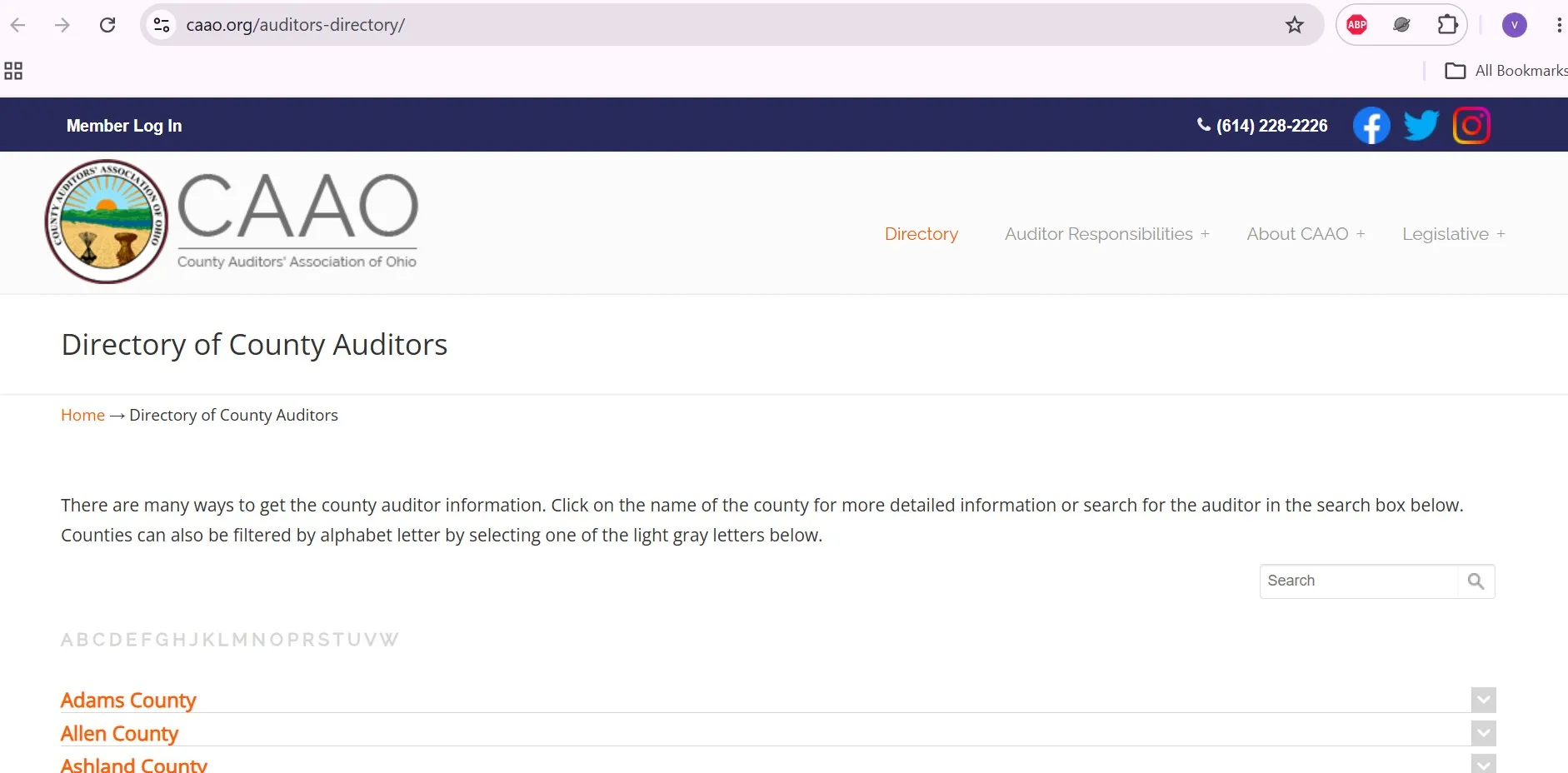
Find the correct Ohio county auditor
The official CAAO directory covers Ohio’s 88 county auditors. It allows users to type a county or auditor name, filter counties alphabetically, and open a county entry containing office information and an official website link.
Use the directory in five steps
After following the county-identification steps above, open the official directory and select the county’s government or auditor website.
Which Ohio county office handles each property task?
Many failed property searches are actually office-routing problems. The auditor, treasurer, recorder and engineer or GIS department do not perform the same job.
What you need |
Correct office or tool |
What it usually provides |
Important limit |
|---|---|---|---|
Owner, parcel, value or property card |
County Auditor |
Ownership display, parcel number, market value, taxable value, land, buildings, transfers and tax summary. |
The owner display is not a title opinion. |
Tax bill, due date or payment |
County Treasurer |
Bills, payment methods, posting, penalties, delinquency and payment plans. |
The auditor normally does not process the tax payment. |
Deed, mortgage, lien or easement |
County Recorder |
Recorded instruments, document indexes, images and certified-copy information. |
A public search is not title insurance. |
Parcel map or aerial image |
Auditor GIS or county GIS |
Parcel location, map layers, aerial photography and nearby parcels. |
GIS lines are not legal survey boundaries. |
Survey, plat or legal description |
County Engineer and Recorder |
Tax maps, surveys, subdivision plats and recorded legal descriptions. |
Online availability varies by county and record age. |
Challenge the property value |
County Board of Revision |
DTE 1 complaint filing, hearing and value decision. |
The board reviews value, not general dissatisfaction with tax rates. |
Homestead, owner occupancy or CAUV |
County Auditor |
Applications, local instructions, eligibility review and renewal information. |
Each program has separate qualifications. |
Search an Ohio property without excluding the record
Search interfaces differ by county, but the same strategy works in most systems: begin with one broad field, review the results, and add detail only when necessary.
- Enter the surname only.
- Run the search before adding the first name.
- Add the first initial if too many results appear.
- Remove punctuation, middle names and suffixes if no record appears.
- Try a trust, LLC, estate, former surname or previous owner.
- Enter the house number.
- Add the main street word.
- Leave out Street, Road, Avenue and directional letters initially.
- Remove apartment numbers and punctuation.
- Compare township and taxing-district information.
- Copy the identifier from a tax bill or prior property card.
- Enter the complete number first.
- Try it without spaces, dashes or dots if necessary.
- Check zero and letter-O characters.
- Verify the address before using the result.
What to do after a result appears
Information worth saving
No Ohio property result found? Follow this order
Understand the Ohio auditor property card
Field |
What it means |
Practical next step |
|---|---|---|
Parcel number |
The county’s identifier for the parcel. |
Save it for taxes, maps, deeds, forms and office calls. |
Owner |
The ownership name currently displayed on the tax record. |
Use the recorded deed when legal ownership proof is required. |
Mailing address |
The address used for tax correspondence. |
Do not confuse it with the physical property location. |
True or market value |
The county auditor’s estimate of fair market value. |
Check building facts and valid recent sales before disputing it. |
Taxable or assessed value |
Generally 35% of true value in Ohio. |
Do not treat it as the final tax bill. |
Land value |
The portion of value assigned to land. |
Check acreage, use, frontage and CAUV status. |
Improvement value |
The portion assigned to buildings and improvements. |
Review square footage, age, condition and outbuildings. |
Property class |
The recorded use classification. |
Contact the auditor if actual use differs materially. |
Taxing district |
The group of jurisdictions and levies applying to the parcel. |
Use the parcel-specific district rather than another property’s rate. |
Transfer history |
Dates, prices or document references for recorded transfers. |
Check the transaction type before using it as a comparable sale. |
Check these physical facts
- Living area and floor area
- Year built and effective age
- Condition and grade
- Basement and finished area
- Garage, barn and outbuilding records
- Acreage and lot size
- Property use or class
- Road frontage
- CAUV status
- Parcel split or combination history
Market value, taxable value and the tax bill are different
Ohio rules generally place real property on the tax duplicate at 35% of its true or market value. That taxable value is then used with the parcel’s effective tax rates, reduction factors, credits and special assessments.
Why values change
Ohio requires a complete countywide reappraisal once during each six-year period.
A value update generally occurs in the third calendar year after the six-year reappraisal.
New construction, demolition, damage, splits, combinations and corrections can affect individual parcels between cycles.
What auditors consider
Ohio valuation rules allow consideration of physical construction, condition, depreciation, obsolescence, location, use, income-producing capacity and the market value of similar properties.
After understanding the difference between market and taxable value, use the official Ohio rules when you need the legal assessment percentage or reappraisal schedule.
Check and pay Ohio property taxes safely
The county auditor calculates and certifies property values and tax information, but the county treasurer collects the bill. Due dates, online-payment processors, card fees, e-check fees, drop boxes and payment-plan options vary by county.
Online payment micro steps
Bill not received
Find Ohio deeds, mortgages, liens and plats
Use the county recorder when you need the actual recorded document. Auditor records usually show ownership and transfer clues, while the recorder maintains deeds, mortgages, plats, liens, easements, releases and other official instruments.
Search recorded documents
After copying the parcel and transfer details, use the official Ohio recorder statute to understand the types of documents kept in county official records and current online-access requirements.
Use Ohio county GIS maps correctly
County GIS systems can help locate a parcel, view nearby properties, compare aerial imagery and identify available political, zoning, flood, soil or utility layers. Available tools differ by county.
GIS map micro steps
Which record should you use?
Record |
Best use |
Limit |
|---|---|---|
GIS parcel map |
Location, nearby parcels, aerial imagery and preliminary research. |
Not a legal survey. |
Recorded deed |
Ownership conveyance and legal-description language. |
May refer to older surveys or monuments. |
Subdivision plat |
Lots, easements, streets and recorded subdivision layout. |
May not show later field conditions. |
Boundary survey |
Professional boundary research and field evidence. |
Confirm that it applies to the current parcel configuration. |
Challenge an Ohio property value
A Board of Revision complaint addresses valuation, assessment, classification or certain related determinations. It does not simply remove a levy or reduce taxes because the bill increased.
Review the record before filing
Prepare the complaint
After preparing the parcel facts and evidence, review the official Ohio complaint statute and then follow the county auditor’s local filing instructions.
Check Ohio property-tax reduction programs
Applications are filed through the county auditor. Eligibility, documents and filing periods should be checked with the county where the property is located.
Program |
Main purpose |
Who should investigate it |
Important warning |
|---|---|---|---|
Owner-occupancy reduction |
Reduction for qualifying owner-occupied residential property. |
Owners using the home as their principal residence. |
A second home or rental may not qualify. |
Homestead Exemption |
Additional relief for qualifying homeowners. |
Eligible senior, disabled, veteran or surviving-spouse applicants. |
Age alone may not establish eligibility. |
CAUV |
Values qualifying agricultural land according to agricultural use. |
Owners of land meeting acreage, use and income requirements. |
Annual renewal and recoupment rules can apply. |
Damaged-property deduction |
Requests value relief after qualifying damage or destruction. |
Owners with fire, storm, demolition or other qualifying loss. |
Document the date and extent of damage promptly. |
Application preparation checklist
Open a detailed county property-search guide
Use these county-specific guides after confirming where the property is located. Each county can use different search software, parcel formats, payment pages and map systems.
Property-search help for Columbus and surrounding Franklin County communities.
Open Franklin County guideParcel, value and tax-record guidance for Cleveland and Cuyahoga County.
Open Cuyahoga County guideProperty-record and parcel-search help for Cincinnati and Hamilton County.
Open Hamilton County guideAuditor property-search help for Dayton and Montgomery County.
Open Montgomery County guideParcel, tax and value-search guidance for Akron and Summit County.
Open Summit County guideOhio county auditor property search FAQs
Is there one statewide Ohio property-record search?
No single parcel-search interface works identically for all 88 Ohio counties. First identify the county, open its official county auditor website, and then use that county’s owner, address or parcel-number search.
How do I find the correct Ohio county auditor?
Use the official County Auditors’ Association of Ohio directory. Search the county name or use the alphabetical filters, open the county listing and then follow the listed official auditor website.
How do I search Ohio property records by owner name?
Begin with the owner’s surname only. Add the first name or initial only if too many results appear. Try former names, trust names, business names and previous owners when a recent transfer is not yet displayed.
Why is an Ohio property address not appearing?
Remove the street suffix, directional letter, apartment number and punctuation. Search with the house number and main street word, then try the parcel map or previous owner if the address is new or recently changed.
What is an Ohio parcel number?
A parcel number is the county identifier assigned to a piece of real property. Formats differ by county, but the parcel number is usually the most reliable identifier for tax, GIS, deed, exemption and valuation questions.
Why is Ohio assessed value lower than market value?
Ohio real property is generally placed on the tax duplicate at 35 percent of its true or market value. A property with a market value of $250,000 would therefore have a taxable value of approximately $87,500 before other tax calculations.
How often are Ohio property values updated?
Ohio requires a countywide reappraisal once every six years. A value update generally occurs in the third calendar year after the sexennial reappraisal, while annual maintenance can reflect new construction, demolition, splits and other changes.
Where do I pay Ohio property taxes?
Property taxes are paid through the county treasurer for the county where the property is located. The county auditor provides values and parcel data, but the treasurer handles bills, payments, delinquency and payment posting.
Where can I find an Ohio deed or mortgage?
Use the county recorder’s official-record system. County recorders maintain deeds, mortgages, plats, liens, easements, releases and other recorded instruments, while the auditor property record provides only summary ownership and transfer clues.
When can I challenge an Ohio property value?
A valuation complaint is generally filed with the county auditor for presentation to the county Board of Revision by March 31 of the following year or the first-half collection closing date, whichever is later. Verify the exact local filing date and use the current DTE 1 form.

Khushboo Bobade is the editor and digital publisher of CountyAuditors.org. She oversees the research and editorial process for the website, ensuring that information about county auditor offices, property records, and government resources is accurate, verified, and easy for visitors to understand.
10 Ohio Property Tax Calculators & Auditor Tools
Built specifically for Ohio's 35% assessment ratio, current DTE forms, and 2026 Homestead, Owner-Occupancy, CAUV, Conveyance Fee, and Board of Revision rules. Every number reflects verified Ohio Department of Taxation amounts.
Annual Tax Bill Estimator
OHIOApplies Ohio's 35% assessment ratio plus your county's effective millage tier — the actual math your auditor uses.
Homestead Reduction Calculator
DTE 105A2026 Ohio Homestead: $29,000 general or $58,000 enhanced (100% disabled vet, KIA spouse). OAGI under $41,000 required for non-veteran applicants.
Owner-Occupancy & Non-Business Credits
DTE 105CEvery Ohio owner-occupied home qualifies for the 2.5% Owner-Occupancy Credit plus the automatic 10% Non-Business Credit. Most owners don't realize these stack.
Conveyance Fee Calculator
ORC 322When you sell or transfer Ohio property, the auditor collects $1 state + up to $3 county per $1,000, plus $0.50 per parcel. Counties choose their rate.
CAUV Agricultural Savings
DTE 109Ohio's Current Agricultural Use Value cuts taxable value dramatically for farmland (10+ acres, or smaller with $2,500+ annual gross income).
Mill Rate Converter
Ohio tax rates appear three ways on auditor sites: mills, percent, or dollars per $1,000. Convert between them instantly.
Parcel Number Cleaner
Ohio's 88 counties each format parcels differently — Franklin uses 010-123456-00, Cuyahoga uses 001-23-456, Hamilton uses 100-0001-0001-00. Auto-detects.
35% Ratio Sanity Check
Ohio law sets taxable value at 35% of market value. If yours is significantly higher, you're a strong BOR appeal candidate.
BOR Appeal Savings
DTE 1A successful Board of Revision complaint typically cuts your value 10–20%. Filing is free and stays in effect until the next reappraisal.
BOR Deadline Countdown
MAR 31Ohio's statutory Board of Revision filing deadline is March 31 for the prior tax year. Miss it and you wait until next year — no extensions.
Verify with the official Ohio source
These calculators use the verified 2026 Ohio Department of Taxation amounts and statutory rules. For your exact bill, exemption status, and county-specific deadlines, always confirm with your county auditor and the Ohio Revised Code:
Estimates use Ohio's 35% statutory assessment ratio and effective tax rate tiers averaged across major Ohio counties. Your actual bill depends on local school levies, voted millage, inside vs. outside millage splits, House Bill 920 reduction factors (HB 920), and special assessments. The 2026 Homestead general amount ($29,000) and enhanced amount ($58,000) reflect HB 187 inflation indexing — your county auditor's office may show slightly different transitional figures. Nothing here is legal or tax advice. CountyAuditors.org is an independent informational directory, not affiliated with any county government.