Find Property Records, Taxes & Maps
Search Lorain County real-estate or manufactured-home records by owner name, street address or property number, then use the parcel page to understand appraised value, assessed value, taxes, sales, building details, credits and map information.
This guide explains exactly what to enter, which tax year to select, how to fix a failed search, what every important result means and when to move from the Auditor to the Treasurer, Recorder, GIS/Tax Map or Board of Revision.
Quick answer: start with the Auditor search
Use the official Lorain County Auditor search when you need an owner, property number, address, value, sales history, tax district, manufactured-home record or parcel map. For current real-estate information payable during 2026, choose tax year 2025 payable 2026, start with one clean search field and verify the result with both the property number and address.
Room 200
Elyria, OH 44035
The Auditor homepage currently announces Friday closures.
Call before traveling, especially for transfers, maps or deadline-sensitive filings.
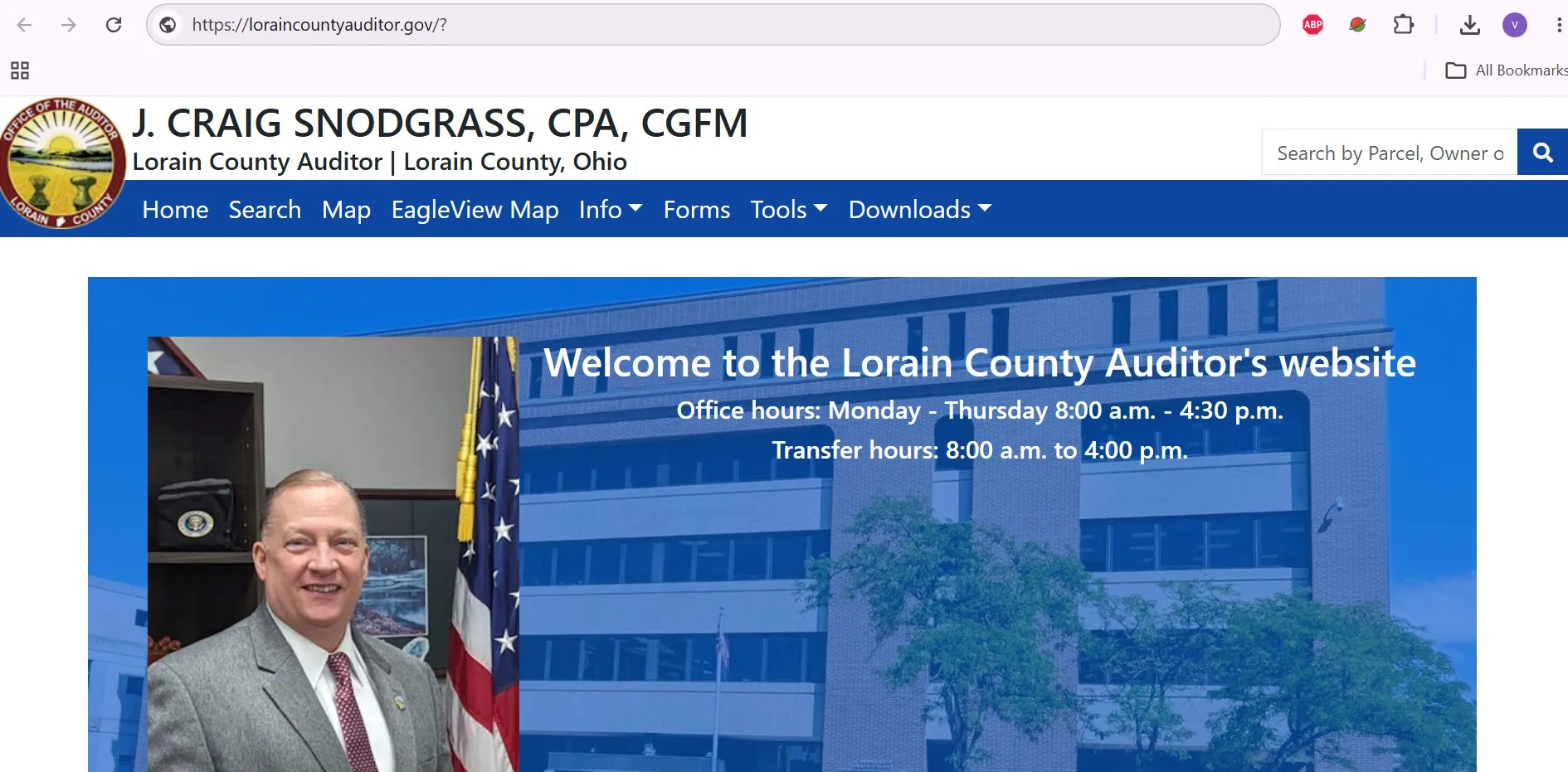
After following the four steps above, open the official county search. The search supports separate Name, Location, Number, Sales and Custom workflows and lets users include Real Estate, Manufactured Home or both property types.
Choose the property problem you need to solve
This guide is organized around real actions rather than a directory of county links.
Which official Lorain County tool handles your task?
A property can appear in several county systems. The Auditor identifies and appraises the parcel, the Treasurer collects taxes, the Recorder stores recorded land documents and GIS/Tax Map provides map and legal-description support.
Your task |
Use this office or tool |
What it provides |
Important limit |
|---|---|---|---|
Find owner, address, value or property number |
Auditor Search |
Parcel identity, valuation, building facts, taxes, sales and property class. |
The owner display does not replace a recorded deed. |
Check or pay a tax bill |
County Treasurer |
Current balances, payment status, due dates, escrow and delinquency help. |
The Auditor does not collect or post payments. |
Find a deed, mortgage, lien or easement |
County Recorder |
Recorded-document indexes, images and certified-copy help. |
Recorder staff do not perform a title search or resolve ownership disputes. |
View parcel lines or aerial imagery |
GIS Parcel Viewer |
Map layers, aerial context, nearby parcels and open data. |
Displayed lines are not a legal survey. |
Request a printed map or legal-description review |
GIS / Tax Map |
Map requests, parcel numbering, split/plat and description support. |
A reference is required for printed-map requests. |
Challenge market value or classification |
Board of Revision |
DTE complaints, hearing guidance and case search. |
It reviews valuation or classification—not dissatisfaction with a tax rate. |
Apply for Homestead, owner occupancy or CAUV |
Auditor Forms |
Applications, renewals, worksheets and filing guidance. |
Each program has separate eligibility and deadlines. |
Search by owner, address or property number
Do not fill every field on the first attempt. One suffix, unit, spelling or tax-year mismatch can remove the correct property from the results.
- Choose the current real-estate or manufactured-home tax year.
- Enter the last name first.
- Add the first name only when too many results appear.
- For an LLC, trust or estate, try one distinctive word.
- Keep both property types checked when uncertain.
- Enter the street number.
- Add the main street name.
- Leave direction, suffix and unit blank initially.
- Add city or ZIP only if the results are too broad.
- Open the result and confirm the city or township.
- Copy the number from a tax bill, deed or prior parcel page.
- Enter the complete number in the Auditor Number Search.
- Check for missing zeros or transposed digits.
- If a split occurred, also search the owner or address.
- For the Recorder portal, remove every dash.
Select the correct tax year and property type
For taxes payable during 2026, the current search commonly displays 2025 payable 2026.
Use an older tax year when comparing past values or tax history.
Manufactured-home records can use a different current-year label from ordinary real estate.
Keep both property types selected when you are not sure how the record is classified.
Open and verify the parcel
After learning the best input order above, use the separate official search page that matches the information you already have.
No Lorain County property result found?
Follow this order before assuming the property is outside the county or paying a third-party records website.
Prepare this before calling
Understand the Lorain County property record
The parcel page combines identity, ownership, valuation, buildings, sales, credits and tax information. Use this field guide before assuming that one number represents the entire property-tax situation.
Field |
Meaning |
Practical next action |
|---|---|---|
Property number |
The county identifier assigned to the property. |
Save it for taxes, maps, Recorder searches, forms and calls. |
Owner |
The ownership name currently displayed by the Auditor. |
Use the recorded deed when proof of legal ownership is required. |
Deeded-owner address |
The address connected with the deeded owner record. |
Compare it with the taxpayer and physical-property addresses. |
Taxpayer address |
The mailing address used for tax correspondence. |
Contact the county if a bill is going to the wrong address. |
Appraised value |
The Auditor’s 100% estimate of market value. |
Compare property facts, condition and valid sales before disputing it. |
Assessed value |
The parcel page displays assessed value at 35% of appraised value. |
Use the correct tax district and effective rates when estimating tax. |
Land and improvements |
Separate value assigned to land and buildings or other improvements. |
Check acreage, square footage, outbuildings and property use. |
Tax district |
The local combination of taxing authorities applying to the parcel. |
Do not compare the tax rate with a property in another district. |
School district |
The school district associated with the parcel. |
Use it when reviewing levy lines and comparable properties. |
Sale date and price |
The transfer information currently linked to the parcel. |
Check the deed and sale type before calling it a market transaction. |
Credits and reductions |
May include HB 920, non-business, owner occupancy, Homestead or other adjustments. |
Confirm eligibility and whether the credit is actually appearing. |
Special assessment |
A separate charge associated with the parcel. |
A value complaint may not remove a special-assessment line. |
Appraised value is not the final tax bill
Lorain County parcel pages display appraised value at 100% and assessed value at 35%. The tax bill can also reflect effective rates, HB 920 reductions, non-business and owner-occupancy credits, Homestead, the Inflation Cap Credit, voted levies and special assessments.
Save a complete property record
Check tax dates, bills and monthly-payment options
This deadline has passed.
Current published due date.
Payments, bills and balances.
Mortgage liaison and prepayment questions.
Use the Treasurer when the question is payment—not value
Tax bill abbreviations users often misunderstand
Bill label |
Meaning |
Why it matters |
|---|---|---|
CO GEN FUND |
County General Fund. |
A county funding line, not a parcel-data error. |
BOND RETIRE |
County Bond Retirement. |
A debt-service line. |
MET PARK |
Lorain County Metropolitan Park District. |
A levy or funding line rather than an Auditor-added fee. |
LCCC |
Lorain County Community College. |
A common countywide bill abbreviation. |
911 |
Lorain County 9-1-1 Agency. |
Emergency-service funding. |
SPECIAL |
A special assessment associated with the parcel. |
A BOR value complaint may not solve this charge. |
Monthly real-estate tax escrow program
The Treasurer offers a no-service-charge prepayment plan for current, non-delinquent semiannual real-estate taxes. The office divides the current semiannual tax into estimated monthly payments over a 10-month cycle and provides coupons.
March, April, May and June coupons, followed by the remaining balance in July.
October, November, December and January coupons, followed by the remaining balance in February.
After reviewing the tax-year and payment checks above, use the official Treasurer search or contact the office at 226 Middle Avenue, second floor, Room 201, Elyria.
Use Lorain County GIS and Tax Map correctly
GIS is useful for locating a parcel, comparing nearby lots, reviewing aerial imagery and accessing available layers. Tax Map staff also help with map requests, parcel numbering, splits, plats and legal-description questions.
Find and examine a parcel map
Printed map requests
Property number, address, map reference, requested size and intended use.
Once you have the property number and understand the map limits, use the official GIS/Tax Map page to open the Parcel Viewer, GIS Portal or Open Data Portal.
Find deeds, mortgages, liens and easements
Use the Recorder when you need the recorded document itself. The Auditor record can identify the property and owner, but the Recorder holds deeds, mortgages, releases, easements, liens and other land-related instruments.
Recorder property-search steps
Which recorded document should you look for?
Your question |
Likely document |
Important caution |
|---|---|---|
Who received ownership? |
Deed |
Read the legal description and ownership interest, not only the index name. |
Was financing recorded? |
Mortgage |
A later release or satisfaction may affect whether it remains active. |
Was a mortgage paid or released? |
Mortgage release or satisfaction |
Search the lender and owner variations. |
Does another party have access rights? |
Easement |
Interpretation may require legal or title help. |
Does a recorded claim exist? |
Lien |
Recorder staff do not determine whether every lien remains enforceable. |
Room 102
Elyria, OH 44035
Monday–Friday, 8:00 a.m.–4:00 p.m.
Review value before filing an appeal
Lorain County completed a 2024 reappraisal and publishes a 2024 Reappraisal Sales Book. Before disputing value, compare the parcel’s physical facts, recent valid sales and the difference between maintenance and a new improvement.
Run a focused sales search
- Sale amount
- Sale-date range
- Valid Sale checkbox
- Tax year
- Year built
- Living area
- Number of stories
- Bedrooms
- Acreage
- Land use
- Tax district
- School district
Maintenance that normally should not create a separate value increase
Improvements that may increase taxable value
Use the tax estimator carefully
The official estimator requests the property class, tax district, proposed appraised value and owner-occupancy eligibility. Use the exact parcel tax district rather than selecting a nearby municipality or school district by guess.
Challenge an incorrect Lorain County value
The Board of Revision can review real property, manufactured or mobile homes taxed like real estate, CAUV determinations and certain classifications. It can increase, decrease or leave the value unchanged.
File correctly when the next window opens
Rules users often miss
Rule |
Official detail |
Practical meaning |
|---|---|---|
Filing fee |
There is no filing fee. |
Do not pay a third party merely to obtain the county complaint form. |
Mail filing |
Regular U.S. mail is accepted and postmark controls the filing date. |
Keep mailing and notarization proof. |
Three-year limitation |
Generally one complaint during each three-year period between reappraisals and updates. |
Make the complaint complete and evidence-based. |
Possible exceptions |
Arm’s-length sale, substantial improvement, casualty loss or qualifying commercial occupancy change. |
Document the exception rather than assuming it applies. |
Possible outcome |
The Board may increase, decrease or retain value. |
A complaint is not a guaranteed reduction. |
After reviewing the evidence and risk above, use the Board page for the current forms, case search, hearing schedule and filing instructions.
Check Homestead, owner occupancy and CAUV
Program |
Main purpose |
Key eligibility clue |
Important action |
|---|---|---|---|
Owner Occupancy |
2.5% reduction on qualifying owner-occupied residential property. |
Owner must occupy the home as the principal residence on January 1. |
Use DTE 105C; a homeowner and spouse can claim only one home. |
Homestead |
Additional relief for qualifying homeowners. |
Age, disability, income, veteran or surviving-spouse requirements may apply. |
Use the correct DTE 105 form and include required identification. |
CAUV |
Values qualifying farmland using agricultural productivity. |
10+ acres or the qualifying income route for a smaller tract. |
Initial DTE 109, $25 fee and annual renewal. |
Damaged property |
Requests a value deduction after qualifying damage or destruction. |
Sudden or documented property damage. |
Use the current DTE 26 and retain photographs and reports. |
Owner Occupancy reduction
The property owner must own and occupy the home as the principal place of residence on January 1 of the filing year. The county says the 2.5% calculation applies to the dwelling and up to one acre of land, and the owner and spouse may claim the reduction on only one home.
Homestead application reminders
CAUV agricultural valuation
- Commercial agricultural use for the prior three calendar years
- Property totaling 10 acres or more
- Or less than 10 acres with average yearly gross income of at least $2,500
- Or certain qualifying federal land-retirement or conservation use
- One-time non-refundable $25 initial fee
- Application between the first Monday in January and first Monday in March
- Annual renewal mailed by approximately January 15
- Income or land-use evidence when requested
Transfer property without avoidable rejection
The Auditor’s Real Estate Department accepts transfers in person and electronically. The office does not accept mailed transfers and will return documents that are incomplete or submitted with incorrect fees.
Current transfer rules
Prepare this transfer packet
Rental-property registration after a purchase
The registration rule can apply to an individual owner, trust, estate, partnership, limited-liability company, association or corporation. The responsible contact person depends on the ownership structure.
Contact the correct Lorain County office
Office |
Use it for |
Contact |
Address and hours |
|---|---|---|---|
Auditor |
Parcel records, values, corrections, Homestead, owner occupancy, CAUV, transfers and BOR. |
226 Middle Ave., Room 200, Elyria, OH 44035. Current 2026 notice says closed Fridays. |
|
Treasurer |
Tax bills, payments, balances, escrow and delinquency. |
226 Middle Ave., 2nd Floor, Room 201, Elyria, OH 44035. 8:00 a.m.–4:30 p.m., Monday–Friday, excluding closures. |
|
Recorder |
Deeds, mortgages, liens, easements, releases and certified copies. |
226 Middle Ave., Room 102, Elyria, OH 44035. 8:00 a.m.–4:00 p.m., Monday–Friday. |
|
GIS / Tax Map |
Parcel maps, printed maps, numbering, plats and map requests. |
Auditor’s Office, 226 Middle Ave., Room 200, Elyria.
Call before visiting.
|
|
CAUV |
Initial applications, annual renewal, soil values, agricultural-use and forestry questions. |
Auditor’s Office, 226 Middle Ave., Room 200, Elyria.
|
Include these details in a call or email
Could the property be recorded in a neighboring county?
Mailing addresses and roads near county borders can create confusion. Confirm the county before repeatedly searching Lorain County.
Useful for properties near the eastern Lorain County boundary and Cleveland-area mailing addresses.
Open Cuyahoga County property-search guideUseful for parcels near the southeastern and southern Lorain County boundary.
Open Medina County property-search guideUseful for properties west of Lorain County or near Vermilion-area county boundaries.
Open Erie County property-search guideWhat the online property search cannot prove
- Finding a property and current owner display
- Reviewing values, buildings and sales
- Checking taxes, credits and districts
- Locating deeds, maps and forms
- Preparing questions for the correct office
- Legal ownership and marketable title
- Exact property boundaries
- Unreleased liens and easements
- Building, zoning or flood approval
- Purchase, lending or legal decisions
Lorain County property search FAQs
How do I search Lorain County property records by owner name?
Open the official Lorain County Auditor Name Search, choose the appropriate tax year and begin with the owner’s last name or one distinctive business or trust word. Keep both Real Estate and Manufactured Home selected if the property type is uncertain, then verify the result using the property number and address.
Can I search Lorain County property records by street address?
Yes. Use the official Location Search and begin with only the street number and main street name. Add the direction, street suffix, unit, city or ZIP only when the first search is too broad.
What tax year should I select in the Lorain County Auditor search?
For current real-estate records payable during 2026, select tax year 2025 payable 2026. Manufactured-home records may use a different current-year label, so confirm the property type and year shown in the official search.
Why is a recently purchased Lorain County property still under the former owner?
The recorded deed and Auditor display may update at different times. Search the former owner, check the Lorain County Recorder’s property-search portal and contact the Auditor if the deed is recorded but the parcel display remains unchanged.
What is the difference between appraised value and assessed value?
The Auditor parcel page displays appraised value at 100 percent and assessed value at 35 percent. The final tax bill also reflects effective tax rates, reduction factors, credits, levies and special assessments.
Are Lorain County GIS parcel lines legal property boundaries?
No. GIS parcel lines are useful for locating and comparing parcels but are not a legal boundary survey. Use recorded deeds, plats and surveys and consult a qualified survey professional before making a fence, construction or boundary decision.
How do I find a Lorain County deed, mortgage, lien or easement?
Use the Lorain County Recorder’s Property Search. The portal supports searches by legal name, parcel number and date. When searching by parcel number, remove all dashes before entering it in Advanced Search.
How do I challenge a Lorain County property value?
Use the proper Board of Revision form, accurately list every owner, address and parcel number, sign and notarize it and file after January 1 but by or postmarked by March 31. There is no filing fee, but evidence should support the requested value.
What is the difference between Homestead, owner occupancy and CAUV?
Owner occupancy is a 2.5 percent reduction for an eligible principal residence. Homestead provides additional relief for qualifying senior, disabled, veteran or surviving-spouse homeowners. CAUV values qualifying agricultural land according to agricultural productivity rather than ordinary development potential.
Who should I call about Lorain County property-tax payment problems?
Call the Lorain County Treasurer at 440-329-5787 for bills, payments, escrow, delinquency and account questions. Call the Auditor at 440-329-5207 for parcel facts, values, owner occupancy, Homestead, CAUV and Board of Revision questions.

Khushboo Bobade is the editor and digital publisher of CountyAuditors.org. She oversees the research and editorial process for the website, ensuring that information about county auditor offices, property records, and government resources is accurate, verified, and easy for visitors to understand.
10 Ohio Property Tax Calculators & Auditor Tools
Built specifically for Ohio's 35% assessment ratio, current DTE forms, and 2026 Homestead, Owner-Occupancy, CAUV, Conveyance Fee, and Board of Revision rules. Every number reflects verified Ohio Department of Taxation amounts.
Annual Tax Bill Estimator
OHIOApplies Ohio's 35% assessment ratio plus your county's effective millage tier — the actual math your auditor uses.
Homestead Reduction Calculator
DTE 105A2026 Ohio Homestead: $29,000 general or $58,000 enhanced (100% disabled vet, KIA spouse). OAGI under $41,000 required for non-veteran applicants.
Owner-Occupancy & Non-Business Credits
DTE 105CEvery Ohio owner-occupied home qualifies for the 2.5% Owner-Occupancy Credit plus the automatic 10% Non-Business Credit. Most owners don't realize these stack.
Conveyance Fee Calculator
ORC 322When you sell or transfer Ohio property, the auditor collects $1 state + up to $3 county per $1,000, plus $0.50 per parcel. Counties choose their rate.
CAUV Agricultural Savings
DTE 109Ohio's Current Agricultural Use Value cuts taxable value dramatically for farmland (10+ acres, or smaller with $2,500+ annual gross income).
Mill Rate Converter
Ohio tax rates appear three ways on auditor sites: mills, percent, or dollars per $1,000. Convert between them instantly.
Parcel Number Cleaner
Ohio's 88 counties each format parcels differently — Franklin uses 010-123456-00, Cuyahoga uses 001-23-456, Hamilton uses 100-0001-0001-00. Auto-detects.
35% Ratio Sanity Check
Ohio law sets taxable value at 35% of market value. If yours is significantly higher, you're a strong BOR appeal candidate.
BOR Appeal Savings
DTE 1A successful Board of Revision complaint typically cuts your value 10–20%. Filing is free and stays in effect until the next reappraisal.
BOR Deadline Countdown
MAR 31Ohio's statutory Board of Revision filing deadline is March 31 for the prior tax year. Miss it and you wait until next year — no extensions.
Verify with the official Ohio source
These calculators use the verified 2026 Ohio Department of Taxation amounts and statutory rules. For your exact bill, exemption status, and county-specific deadlines, always confirm with your county auditor and the Ohio Revised Code:
Estimates use Ohio's 35% statutory assessment ratio and effective tax rate tiers averaged across major Ohio counties. Your actual bill depends on local school levies, voted millage, inside vs. outside millage splits, House Bill 920 reduction factors (HB 920), and special assessments. The 2026 Homestead general amount ($29,000) and enhanced amount ($58,000) reflect HB 187 inflation indexing — your county auditor's office may show slightly different transitional figures. Nothing here is legal or tax advice. CountyAuditors.org is an independent informational directory, not affiliated with any county government.