Find Parcels, Values, Taxes & Maps
Search Logan County property records by owner name, street address or parcel number, then open the complete tax card to review ownership, legal description, acreage, appraised value, assessed value, sales, taxes, payment history, land, buildings and sketches.
This guide explains the exact search format, rural-road abbreviations, map-sale colors, failed-search fixes, tax-payment steps and which office handles deeds, value complaints, Homestead, Owner Occupancy, CAUV, conveyance or manufactured-home questions.
Current tax alert: second-half deadline extended
As of July 21, 2026, the Logan County Treasurer’s current notice says second-half 2025 real-property and public-utility taxes, plus second-half 2026 manufactured-home taxes, are due July 22, 2026.
The extension was issued while Ohio’s Inflation Cap Credit was being calculated. Follow the current Treasurer homepage rather than an older parcel-card or FAQ date.
Quick answer: start with one clean search field
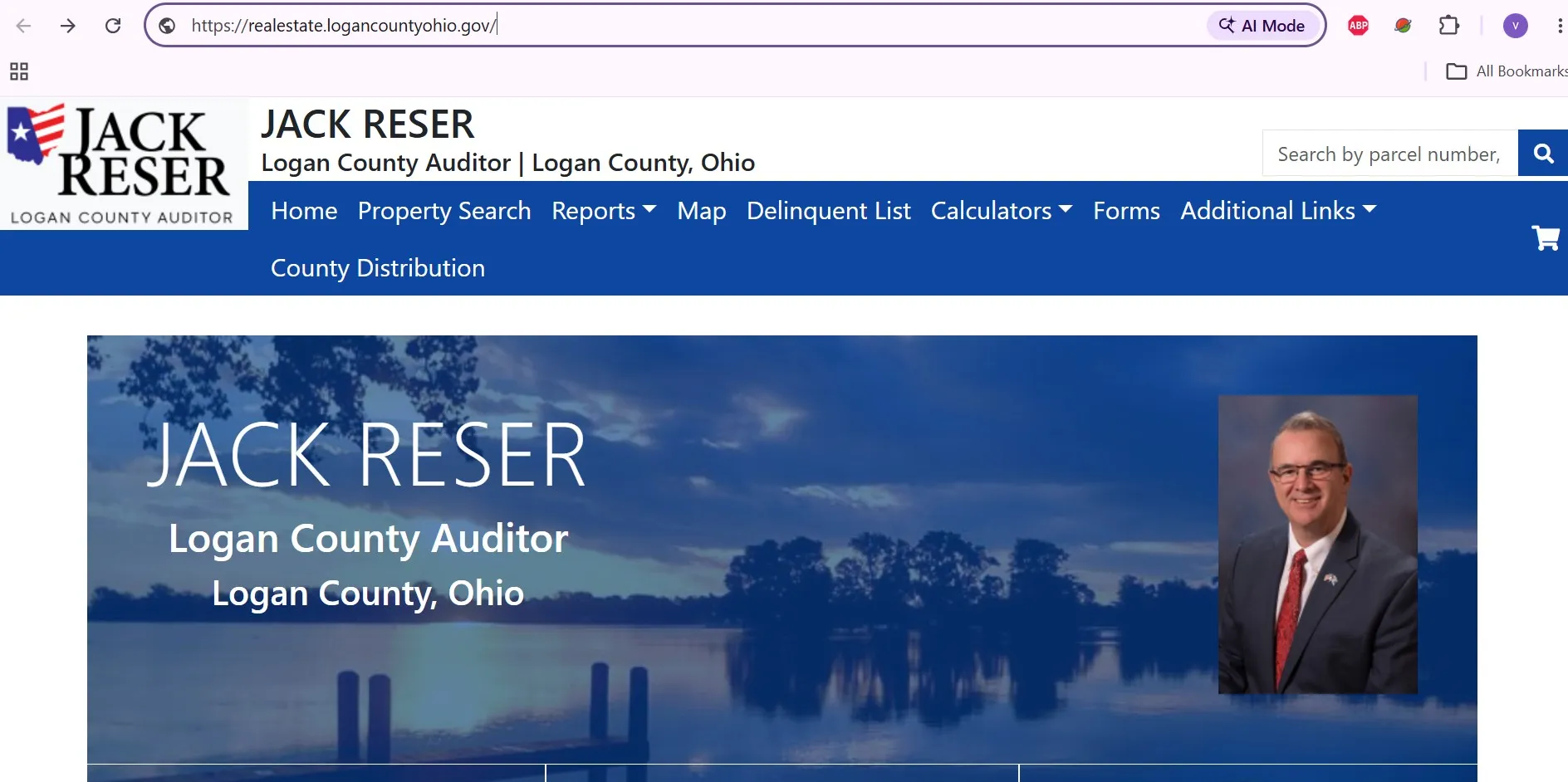
Use the official Logan County Real Estate Search for owner, location, parcel, sales, neighborhood, value, tax and map information. Search with one clue, select the correct parcel, save its property number and then use that same number with the Treasurer, Recorder, GIS or Board of Revision.
Jack Reser
100 S. Madriver St., Room 103
Bellefontaine, OH 43311
After following the four steps above, open the county’s real-estate portal. It provides separate owner, location, number, sales and custom searches and supports both real estate and manufactured-home records.
Choose the exact property task
The guide is organized around real actions instead of sending visitors through unexplained county links.
Which Logan County office handles your question?
Start with the Auditor to identify the property. Move to another office only when you need an action that the Auditor does not control.
Your task |
Correct office or tool |
What it provides |
Important limit |
|---|---|---|---|
Owner, location, parcel or property value |
Auditor Real Estate Search |
Tax cards, values, land, buildings, transfers, payment history, maps and tax information. |
The owner display is not a professional title opinion. |
Tax bill, payment, due date or delinquency |
Treasurer |
Current charges, bills, payments, posting, automatic withdrawal and payment plans. |
Use the Treasurer’s current notice when an old parcel page displays a different date. |
Deed, mortgage, lien or easement |
Recorder |
Recorded documents, document images, indexing and certified-copy help. |
A document search does not replace title work. |
Parcel map, nearby parcels or sales colors |
Auditor GIS Map |
Parcel context and visual sale-to-appraisal indicators. |
Map lines are not legal survey boundaries. |
Legal description or conveyance review |
Engineer / Map Room |
Description review, map research and pre-approval help. |
New or defective descriptions may require a survey. |
Challenge the market value |
Board of Revision |
Formal valuation complaint and hearing process. |
The Board reviews valuation—not general dislike of the tax rate. |
Homestead, Owner Occupancy or CAUV |
Auditor |
Applications, renewals, eligibility information and transfer forms. |
Each program has separate requirements and deadlines. |
Search by owner, address or property number
Logan County provides separate Owner, Location and Number searches. Start with less information and add details only when the result list is too broad.
- Enter the last name first.
- A partial last or first name is allowed.
- Add the first name only when too many results appear.
- Try a middle name, trust, estate, company or former owner.
- Verify the property number and location.
- Enter the house number or street name.
- The full address is not required.
- Leave direction and suffix blank initially.
- Use C R, T R or S R for rural roads and routes.
- Remember that vacant land may have no street number.
- Copy the number from a bill, deed or previous tax card.
- Select the correct tax year.
- Choose Real Estate or Manufactured Home.
- Enter the full number.
- Confirm the location before using the record.
Open the correct property record
Save these details before leaving the search
After understanding the workflow, use the appropriate official search page rather than an unrelated public-record advertisement.
No Logan County property result found?
Follow this order before assuming the parcel is missing.
Prepare before calling Real Estate
Understand the Logan County property record
The detailed parcel page contains separate tabs for summary, tax, transfers, history, payment history, value history, CAUV soil breakdown, utilities, land, buildings, dwellings, improvements, sketch, levy distribution, tax bill, estimator and map.
Field or tab |
What it means |
Practical next action |
|---|---|---|
Property number |
The unique county identifier for the property. |
Use it for tax, deed, map, value and office questions. |
Legal description |
The abbreviated description associated with the tax parcel. |
Use the recorded deed for a complete legal description. |
Map and routing number |
County mapping and internal routing references. |
Provide them when map-room or parcel-location questions are difficult. |
Tax district |
The taxing jurisdiction combination affecting the property. |
Use it when comparing effective rates and tax bills. |
Neighborhood |
The market-area group used for appraisal and reporting. |
Use Neighborhood Report to view similarly grouped properties. |
Deed volume and page |
A recorded-document reference connected with the parcel. |
Use it to narrow the Recorder’s document search. |
Appraised value |
The Auditor’s estimate of full property value. |
Review land, improvements, sales and condition before disputing it. |
Assessed value |
Generally 35% of appraised value under Ohio’s property-tax system. |
Do not apply another property’s tax rate to it. |
CAUV, Homestead and Owner Occupancy |
Indicators showing whether those reductions or valuation programs appear on the parcel. |
Contact the Auditor when an expected indicator shows “N.” |
Full, effective and qualifying rates |
Different rate calculations connected with the tax district and applicable credits. |
Use the parcel’s own figures rather than a countywide estimate. |
Special assessments |
Separate charges such as ditch or other assessments. |
Identify the assessment name before asking why the bill is higher. |
Payment History |
Prior payment dates and amounts. |
Check this before making a duplicate owner or escrow payment. |
2026 tax card |
A card that may include tentative future values. |
Do not confuse tentative values with a final current tax bill. |
Property details worth checking
- Acreage and land-use code
- Tax and school districts
- Neighborhood and subdivision
- Map and routing numbers
- CAUV soil breakdown
- Utility information
- Dwelling style and living area
- Year built, grade and condition
- Bedrooms, bathrooms and stories
- Basement, heating and cooling
- Commercial buildings
- Other improvements and sketch
Use the parcel map and sale colors correctly
Logan County links each parcel to an ArcGIS map. Its search help also describes a visual sale indicator that compares a sale amount with appraised value.
The recorded sale amount was higher than the appraised value used by the visual indicator.
The recorded sale amount was lower than the appraised value used by the visual indicator.
GIS map workflow
After identifying the parcel and understanding the color limits, open the county-linked GIS experience.
Search sales and nearby properties
Logan County’s Sales Search includes sale amount, sale date, year built, living area, stories, bedrooms, acreage, land use, tax district, school district and a Valid Sale filter.
Build a useful sales search
- Tax district
- School district
- Neighborhood
- Township, village or lake area
- Land use
- Living area
- Year built
- Stories, bedrooms and acreage
- Recent date range
- Relevant sale-price range
- Valid Sale selected
- Single-property versus multi-property sale
Use Neighborhood Report for grouped research
Exclude misleading transfers
After choosing appropriate filters, use the official Sales Search and Neighborhood Report.
Check and pay Logan County property taxes
Past deadline.
Current extended deadline.
Eligible bills may show a separate credit line.
Call for current bill questions.
Check the parcel before submitting payment
Online and phone payment fees
Method |
Published processor fee |
Practical reminder |
|---|---|---|
Electronic check |
$1.00, unlimited payment amount. |
Verify routing and account numbers carefully. |
Credit card |
2.35%, with a $2.00 minimum fee. |
Review the fee before submitting a large payment. |
Debit card |
2.35%, with a $2.00 minimum fee. |
A debit card does not use the flat electronic-check fee. |
Phone payment |
Same processor fees apply; call 1-833-440-8638. |
Have the property number and payment information ready. |
Mail |
No processor fee listed for a mailed check. |
Include the bill stub or write the property number on the check. |
In person |
Cash, check and money order avoid online processing; card fees still apply. |
Confirm office hours before a deadline-day visit. |
Bill missing, address wrong or taxes delinquent?
Rhonda K. Stafford
100 S. Madriver St., Suite D
8:00 a.m.–4:30 p.m., Monday–Friday
After reviewing the steps, current deadline and fees above, use the Treasurer’s official search and payment instructions.
Find deeds, mortgages, liens and easements
Use the Recorder when you need a recorded ownership or encumbrance document. The Auditor’s volume and page reference can help locate it, but the tax card itself is not the deed.
Search recorded documents step by step
Current Recorder fees and document rules
Item |
Published amount |
Important note |
|---|---|---|
First two pages |
$39 |
Confirm the total number of pages before arriving. |
Each additional page |
$8 |
Attachments and exhibits may increase the page count. |
Non-standard document fee |
$20 additional |
Ohio margin, paper, ink and font rules apply. |
Marginal reference |
$4 per reference |
Ask the Recorder to confirm how many references apply. |
Payment amount |
Exact fee required |
The Recorder states that the office cannot provide change. |
Patricia A. Myers
100 S. Madriver St.
8:00 a.m.–4:30 p.m., Monday–Friday
After preparing the owner names, document type and date range, use the Recorder’s official Document Search.
Challenge an incorrect Logan County property value
Logan County’s Board of Revision hears formal complaints about property valuations and appraisals. Complaints are accepted from January 1 through March 31 each year.
Check the parcel before filing
Prepare the complaint step by step
Evidence that helps explain the request
After reviewing the property and organizing evidence, open the official Board of Revision page and current Auditor forms.
Check Homestead, Owner Occupancy and CAUV
Program |
Main benefit |
Important 2026 rule |
Contact |
|---|---|---|---|
Owner Occupied Credit |
Reduction for an eligible owner-occupied principal residence. |
Own the home as of January 1 and occupy it as the principal residence; applications run January 1–December 31. |
937-599-7213 |
Homestead Exemption |
Exempts $29,000 of market value for qualifying senior or disabled homeowners. |
2026 application income maximum is $41,000 of 2025 Ohio adjusted gross income for applicable applicants. |
937-599-7209 |
Disabled-veteran Homestead |
Exempts $58,000 of market value for qualifying disabled veterans. |
Use the separate disabled-veteran application and required documentation. |
937-599-7209 |
CAUV |
Values qualifying farmland according to agricultural use rather than ordinary market value. |
File or renew between the first Monday in January and before the first Monday in March. |
937-599-7213 |
Homestead qualification checklist
Owner Occupied Credit limits
The reduction applies to the home and one-acre homesite. The county says rental homes, homes occupied by someone other than the owner, many entity-owned homes and mobile homes not treated as real estate do not qualify.
CAUV qualification and deadline
Land containing 10 acres or more can qualify when devoted exclusively to qualifying agricultural use.
Land under 10 acres can qualify when it produced at least $2,500 gross agricultural income in each of the prior three years or is reasonably expected to produce that amount in the current year.
After identifying the correct program, use Logan County’s official application page rather than an old form saved from another county.
Calculate conveyance and prepare a property transfer
Logan County’s conveyance fee is based on sale price, with a separate transfer fee per parcel. Legal-description review should be handled before the closing or recording date when a split, new survey or questionable description is involved.
$4 per $1,000 of sale price, rounded according to the county calculator.
$0.50 per parcel.
Prepare the transfer step by step
Manufactured-home transfer and movement rules
Action |
Published requirement |
Possible consequence |
|---|---|---|
Transfer title |
Bring a notarized title, complete the conveyance statement and confirm current taxes are paid. |
$100 penalty when the title is not transferred within 30 days. |
Register new title |
Register a copy with the Auditor where the home is located within 30 days. |
An additional $100 fine may apply. |
Move the home |
Obtain a moving permit from the Auditor where the home currently sits. |
$5 permit; failure can create separate $100 fines for the owner and mover. |
Convert to real property |
Permanent foundation, removed wheels and tongue, paid taxes and surrendered lien-free title. |
County lists December 15 as the annual completion deadline. |
After counting parcels, confirming the sale amount and checking the legal description, use the county calculator and forms.
Logan County property office contacts
Office |
Use it for |
Contact |
Location and hours |
|---|---|---|---|
Auditor |
General property records, valuation, Homestead and Board of Revision. |
100 S. Madriver St., Room 103; 8:00 a.m.–4:30 p.m., Monday–Friday. |
|
Real Estate / CAUV / Owner Occupancy |
Parcel facts, property-card corrections, CAUV and Owner Occupancy. |
Auditor’s Office, 100 S. Madriver St. |
|
Treasurer |
Tax bills, payments, posting, automatic withdrawal, delinquency and foreclosure payment plans. |
100 S. Madriver St., Suite D; 8:00 a.m.–4:30 p.m., Monday–Friday. |
|
Recorder |
Deeds, mortgages, liens, easements, record images and recording. |
100 S. Madriver St.; 8:00 a.m.–4:30 p.m., Monday–Friday. |
|
Manufactured Homes |
Title registration, relocation permits, conversion and manufactured-home tax questions. |
Contact the Auditor before bringing a title or moving document. |
Bring or include these details
Check another county only when the location requires it
Logan County directly borders Union County. A Columbus-area mailing address or owner address can also cause searchers to confuse the property’s mailing information with its recording county.
Use this guide when the parcel is near Logan County’s eastern boundary or associated with a Union County jurisdiction.
Union County Ohio property-search guideUse this guide when a Columbus-area mailing address causes uncertainty about the actual recording county.
Franklin County Ohio property-search guideWhat the online property system cannot prove
- Finding a property and owner display
- Reviewing value, land and building data
- Checking sales, taxes and payment history
- Locating map and deed references
- Preparing for a county-office call
- Legal ownership or marketable title
- Exact property boundaries
- Zoning, flood or building permission
- Legal effect of liens and easements
- Purchase, lending or legal decisions
Logan County property search FAQs
How do I search Logan County property records by owner name?
Open the official Logan County Auditor Owner Search and enter the last name first. A partial last or first name is allowed. Begin with fewer letters, then add the first name or middle name only when too many results appear.
How do I search a Logan County property by address?
Enter only the house number or main street name initially. Logan County says the complete address is not required. For rural properties, use C R for County Road, T R for Township Road and S R for State Route.
What information appears on a Logan County property card?
A parcel page can include owner and taxpayer information, parcel number, legal description, acreage, deed volume and page, sales, appraised and assessed values, tax rates, charges, payment history, value history, CAUV soil data, land, dwellings, improvements, sketches, levy distribution and a printable tax bill.
What do the green and red property-sale map markers mean?
Logan County’s property-search help says green indicates that a property sold above its appraised value, while red indicates that it sold below its appraised value. The colors are research clues and do not by themselves prove current market value.
When are Logan County second-half 2025 property taxes due in 2026?
The Logan County Treasurer extended the second-half 2025 real-property and public-utility tax deadline to July 22, 2026 because of implementation work for Ohio’s Inflation Cap Credit.
How much does Logan County charge for online property-tax payments?
The Treasurer currently lists a $1 electronic-check fee and a 2.35 percent fee for credit or debit cards, with a $2 minimum card fee. Review the processor’s final charge before submitting payment.
Are Logan County GIS parcel lines legal boundaries?
No. GIS parcel lines are visual reference information. Use the recorded deed, survey and County Engineer or Map Room review before making a fence, driveway, building, easement or boundary decision.
Where can I search Logan County deeds and mortgages?
Use the official Logan County Recorder page and choose Document Search. Search both current and former owner names, narrow by document type and recording date, and verify the document image and volume or page information.
How do I challenge a Logan County property value?
Review the parcel details, gather recent appraisal or comparable-sale evidence and file the correct Board of Revision complaint. Logan County accepts complaints from January 1 through March 31 each year.
Who should I call about Logan County property records or taxes?
Call the Auditor at 937-599-7209 for general property-record and valuation questions, or the Real Estate division at 937-599-7213. Call the Treasurer at 937-599-7223 for bills, payments, posting, due dates and delinquency questions.

Khushboo Bobade is the editor and digital publisher of CountyAuditors.org. She oversees the research and editorial process for the website, ensuring that information about county auditor offices, property records, and government resources is accurate, verified, and easy for visitors to understand.
10 Ohio Property Tax Calculators & Auditor Tools
Built specifically for Ohio's 35% assessment ratio, current DTE forms, and 2026 Homestead, Owner-Occupancy, CAUV, Conveyance Fee, and Board of Revision rules. Every number reflects verified Ohio Department of Taxation amounts.
Annual Tax Bill Estimator
OHIOApplies Ohio's 35% assessment ratio plus your county's effective millage tier — the actual math your auditor uses.
Homestead Reduction Calculator
DTE 105A2026 Ohio Homestead: $29,000 general or $58,000 enhanced (100% disabled vet, KIA spouse). OAGI under $41,000 required for non-veteran applicants.
Owner-Occupancy & Non-Business Credits
DTE 105CEvery Ohio owner-occupied home qualifies for the 2.5% Owner-Occupancy Credit plus the automatic 10% Non-Business Credit. Most owners don't realize these stack.
Conveyance Fee Calculator
ORC 322When you sell or transfer Ohio property, the auditor collects $1 state + up to $3 county per $1,000, plus $0.50 per parcel. Counties choose their rate.
CAUV Agricultural Savings
DTE 109Ohio's Current Agricultural Use Value cuts taxable value dramatically for farmland (10+ acres, or smaller with $2,500+ annual gross income).
Mill Rate Converter
Ohio tax rates appear three ways on auditor sites: mills, percent, or dollars per $1,000. Convert between them instantly.
Parcel Number Cleaner
Ohio's 88 counties each format parcels differently — Franklin uses 010-123456-00, Cuyahoga uses 001-23-456, Hamilton uses 100-0001-0001-00. Auto-detects.
35% Ratio Sanity Check
Ohio law sets taxable value at 35% of market value. If yours is significantly higher, you're a strong BOR appeal candidate.
BOR Appeal Savings
DTE 1A successful Board of Revision complaint typically cuts your value 10–20%. Filing is free and stays in effect until the next reappraisal.
BOR Deadline Countdown
MAR 31Ohio's statutory Board of Revision filing deadline is March 31 for the prior tax year. Miss it and you wait until next year — no extensions.
Verify with the official Ohio source
These calculators use the verified 2026 Ohio Department of Taxation amounts and statutory rules. For your exact bill, exemption status, and county-specific deadlines, always confirm with your county auditor and the Ohio Revised Code:
Estimates use Ohio's 35% statutory assessment ratio and effective tax rate tiers averaged across major Ohio counties. Your actual bill depends on local school levies, voted millage, inside vs. outside millage splits, House Bill 920 reduction factors (HB 920), and special assessments. The 2026 Homestead general amount ($29,000) and enhanced amount ($58,000) reflect HB 187 inflation indexing — your county auditor's office may show slightly different transitional figures. Nothing here is legal or tax advice. CountyAuditors.org is an independent informational directory, not affiliated with any county government.