Search Parcels, Taxes & Lake Navigator Maps
Find a Lake County property by parcel ID, owner name or street address, then use the parcel record to check ownership, values, land and building details, transfers, tax history, credits and special assessments.
This guide explains the exact search format, wildcard shortcuts, failed-search fixes, record fields, tax-payment options, Lake Navigator map tools, historical aerial imagery, deeds, Homestead, CAUV, value complaints and parcel-transfer steps.
Quick answer: where should you start?
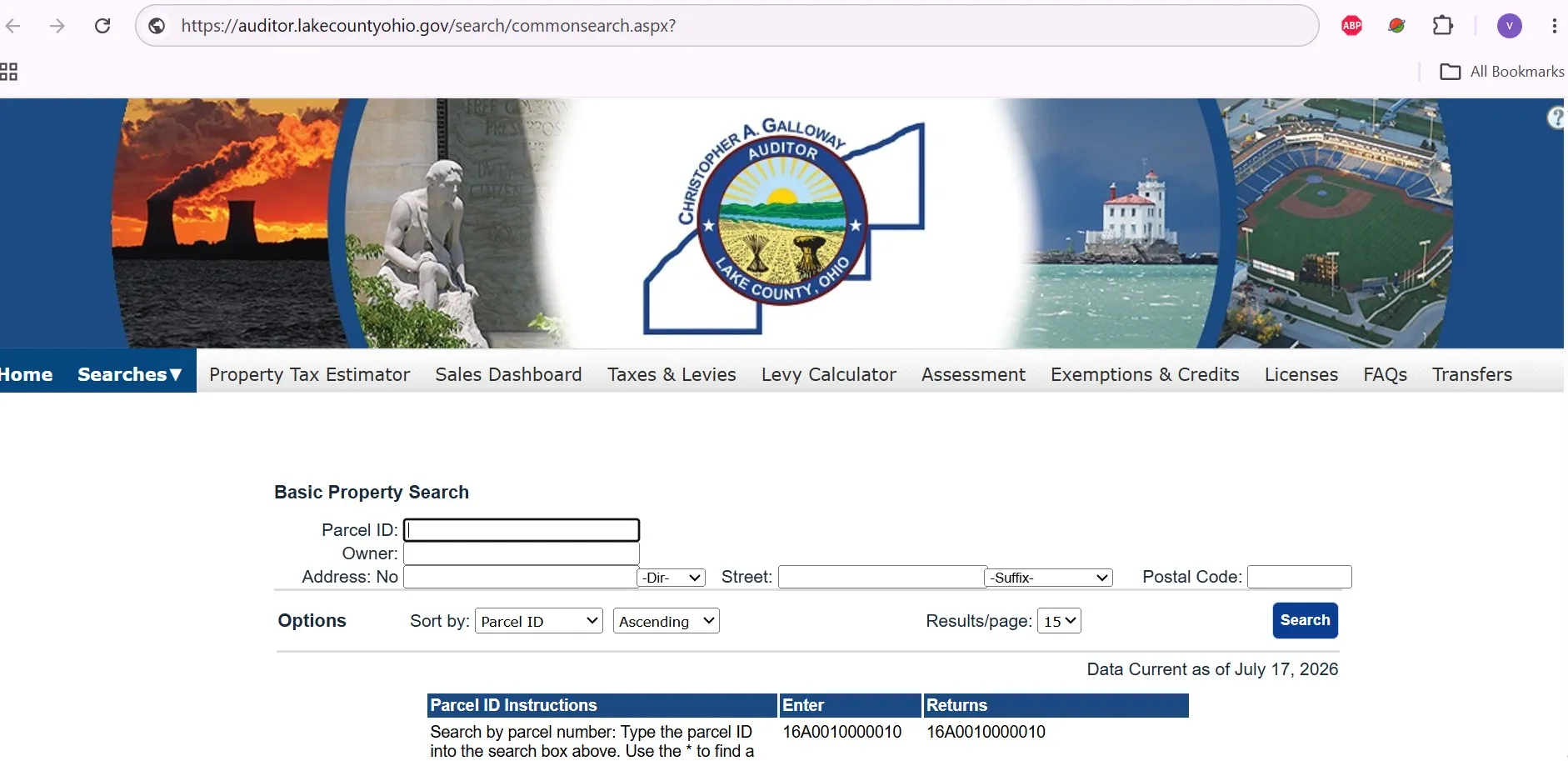
Use the official Lake County Basic Property Search. Search by Parcel ID, owner or street address. For parcel numbers, use capital letters and remove dashes. For addresses, begin with the house number and main street name and leave off the suffix. Use an asterisk as a wildcard when the spelling or complete identifier is uncertain.
Suite C101
Painesville, OH 44077
The public search currently labels its property data current through July 16, 2026. Search dates describe the database update—not a guarantee that every same-day deed, payment or correction is already visible.
Choose the property task you need to complete
Each section solves a separate user problem instead of sending visitors through a generic directory.
Which Lake County office handles your question?
Your task |
Use |
What it provides |
Important limit |
|---|---|---|---|
Find owner, Parcel ID, address or appraisal facts |
Auditor property search |
Parcel profile, values, land, improvements, transfers and tax data. |
Owner display does not replace the recorded deed. |
Search groups of properties or sales |
Advanced or Sales Search |
Filtered research and exportable result lists. |
Too many filters can hide valid records. |
Locate the parcel visually |
Lake Navigator 3.0 or Lake Nav 4.0 Beta |
Parcels, roads, jurisdictions, aerials and more than 30 available layers. |
Parcel lines are not a legal survey. |
Check balance, payment or delinquency |
Treasurer |
Tax notices, payment portal, AutoPay, payment plans and penalty help. |
The Auditor does not collect tax payments. |
Find deed, mortgage, lien or ownership proof |
Recorder |
Official recorded land documents and Property Fraud Alert. |
A property card is not a title examination. |
Challenge appraised market value |
Board of Revision |
Formal DTE 1 complaint, evidence review and hearing process. |
It cannot change tax rates or levy decisions. |
Correct property characteristics |
Appraisal Department |
Review of building, land and appraisal-record errors. |
Provide measurements, photos or other documentation. |
Split or combine property |
Zoning, surveyor, Tax Map, Auditor and Recorder |
Approval, legal descriptions, transfer and recording. |
Most non-administrative changes require a licensed surveyor. |
Search by parcel ID, owner or address
- Copy the number from a tax bill, deed or prior record.
- Use capital letters.
- Remove dashes when following Treasurer search guidance.
- Enter the complete identifier first.
- Use an asterisk to return a group of parcels with the same beginning.
- Enter the last name followed by the first name.
- Start with the last name only.
- Add the first name when results are too broad.
- Use an asterisk inside the name when spelling is uncertain.
- Try the trust, LLC, estate or former owner when relevant.
- Enter the house number.
- Add the main street name.
- Leave off Road, Street, Avenue and similar suffixes first.
- Use an asterisk for uncertain spelling or all properties on a street.
- Add the postal code only when needed to narrow results.
Open and verify the correct parcel
Save these facts
No Lake County property result found?
Understand the parcel profile and tax record
Field |
What it means |
Practical next action |
|---|---|---|
Parcel ID |
The permanent county identifier for the parcel. |
Use it across Auditor, Treasurer, GIS and Recorder workflows. |
Owner |
The ownership name displayed in the Auditor database. |
Use the recorded deed when legal ownership proof is required. |
Tax mailing address |
Where tax notices and correspondence are sent. |
Submit an address correction when bills are going to the wrong location. |
Property class |
Residential, agricultural, commercial, industrial, exempt or another class. |
Contact Appraisal if the recorded use is materially wrong. |
Market value |
The Auditor’s estimate of full property value. |
Review comparable sales and parcel facts before disputing it. |
Assessed value |
Generally 35% of market value under Ohio’s property-tax system. |
Do not estimate the final bill from assessed value alone. |
Land and improvements |
Separate values and characteristics for the site and structures. |
Check acreage, living area, grade, condition and outbuildings. |
Transfer history |
Prior sale or ownership-transfer information. |
Check the transaction type before treating it as a market sale. |
Credits |
Owner Occupancy, Homestead and other qualifying reductions. |
Contact the Auditor when an expected credit is missing. |
Special assessments |
Project or service charges placed separately on the tax duplicate. |
Identify the city, village, township or county office that levied the charge. |
Tax Summary |
Current charges, credits, adjustments, payments and balance. |
Remember that the summary updates nightly. |
Tax Bill |
The formal bill produced for a tax collection. |
The Treasurer says bill views update monthly and can differ from the nightly summary. |
Correct a property-data error
Check the 2026 Lake County tax deadline and payment
Payable during calendar year 2026.
USPS postmark is accepted.
Applies under applicable Ohio law after the deadline.
Not receiving a bill does not remove liability.
Micro steps for payment
Method |
Published details |
Practical warning |
|---|---|---|
E-check |
$0.50 online service fee. |
Check routing and account numbers carefully. |
Credit or debit card |
2.35% published fee. |
Review the final fee before authorizing a large payment. |
Apple Pay or Google Pay |
2.35% published fee. |
Confirm the selected funding source. |
Automated phone |
Call 440-276-4446; enter an asterisk for letters in the Parcel ID. |
Save the confirmation number. |
Mail |
Lake County Treasurer, 105 Main St., Painesville, OH 44077. |
Write the Parcel ID on the check and use a timely USPS postmark. |
In person |
105 Main St., Suite C102, weekdays 8:00 a.m.–4:30 p.m. |
Check holiday or special collection hours before traveling. |
Free semiannual or yearly AutoPay |
A form is required. |
Confirm bank details before the scheduled due-date withdrawal. |
Monthly AutoPay |
Free prepay plan; enrollment generally April 1 through June 21. |
Taxes must be current and catch-up payments may be required. |
Self-guided prepay |
Send any amount during the year; choose “pay other amount” when balance displays zero. |
Remaining January or June bills must still be paid by their due dates. |
Use Lake Navigator and GIS without misreading the map
Lake County offers the established Lake Navigator 3.0, the newer Lake Nav 4.0 Beta, a GIS Hub and downloadable parcel, road, address, jurisdiction and other spatial datasets.
Which GIS resource should you use?
Resource |
Best use |
Important detail |
|---|---|---|
Lake Navigator 3.0 |
Established parcel viewer with search and more than 30 available layers. |
Official help includes search, interface and add-data videos or PDFs. |
Lake Nav 4.0 Beta |
Updated viewer experience and alternative when version 3.0 has issues. |
Beta features can change while testing continues. |
Historical aerial imagery |
Comparing visible property, shoreline, road or development changes. |
Image dates do not prove when a specific structure changed. |
Open Data Download |
Downloading parcels, centerlines, address points and jurisdiction layers. |
Current core layers are updated nightly through the GIS Hub. |
Legacy GIS downloads |
Accessing additional historical or specialized datasets. |
Check the listed creation date before relying on a downloaded layer. |
Printed maps |
Large-format reference or project maps. |
Availability depends on workload; published prices vary by size. |
Painesville, OH 44077
Monday–Friday, 8:00 a.m.–4:30 p.m.
Find deeds, mortgages, liens and fraud alerts
Use the Recorder when you need the actual document that created, transferred or encumbered a property interest. The Auditor record is useful for parcel identification but does not replace a recorded deed.
P.O. Box 49
Painesville, OH 44077
Deeds, mortgages, liens, releases, easements and other official land documents.
Challenge an incorrect Lake County property value
The Board of Revision determines fair market value as of the applicable tax-year lien date. It does not hear complaints that tax rates or voter-approved levies are too high.
Check the record before filing
Four filing methods
Preferred online method; an email address is required.
Complete, sign and notarize the complaint before mailing.
Visit Suite C101; a notary is usually available.
Call 440-350-2221 to ask for a DTE 1 form by mail.
Evidence that matters
Check Homestead and Owner Occupancy
Program |
2026 benefit or purpose |
Basic qualification clue |
Application |
|---|---|---|---|
Standard Homestead |
Exempts $29,000 of qualifying value for the 2026 tax cycle. |
Own and occupy the home; qualifying senior, permanently disabled person or surviving spouse. |
DTE 105A plus required proof. |
Enhanced veteran Homestead |
Exempts $58,000 of qualifying value for the 2026 tax cycle. |
Qualifying 100% service-connected disability or compensation status. |
DTE 105I and veteran documentation. |
Owner Occupancy Credit |
Credit based on the taxing district’s applicable reduction factors and qualifying levies. |
Own and occupy the home as the principal residence on January 1. |
DTE 105C or SmartFile. |
Homestead preparation checklist
Owner Occupancy rules
- The home must be owned and occupied as the principal residence on January 1.
- A homeowner and spouse may receive the reduction on only their qualifying primary residence.
- The property generally must be titled to an individual or qualifying trust.
- Use DTE 105C or the SmartFile paperless filing system.
- Prior missed years generally cannot all be recovered; review the tax bill promptly.
Understand Lake County CAUV
Current Agricultural Use Value can value qualifying farmland according to agricultural productivity rather than ordinary development-market value. Qualification belongs to the land’s use, but the owner must apply and renew.
- Field crops and tobacco
- Fruit and vegetables
- Apiculture and aquaculture
- Nursery stock and timber
- Ornamental trees, sod and flowers
- Animal or poultry husbandry
- Must generally show at least $2,500 average annual agricultural gross income
- Review each of the previous three years
- Anticipated qualifying income may apply during an initial year
- Keep sales, lease and production records
Application and renewal workflow
Transfer, split or combine Lake County property
Transfer an existing parcel
$4 per $1,000 of consideration, rounded according to the county’s published calculator method.
$0.50 per parcel.
Split a parcel
Combine parcels
A simplified combination form may be used only for qualifying residential lots in a recorded subdivision. Other combinations generally require a new survey and legal description. Attach the most recent deeds when using the administrative form.
Lake County property contacts and office routing
Department |
Use it for |
Phone |
Office detail |
|---|---|---|---|
Real Estate / Auditor |
Search, transfers, owner address, Homestead, Owner Occupancy and general property questions. |
105 Main St., Suite C101; 8:00 a.m.–4:30 p.m. |
|
Appraisal / Board of Revision |
Values, assessment records, corrections, abatements, TIF and value complaints. |
Submit evidence with value or data questions. |
|
Agricultural Department |
CAUV, Agricultural District and forestry questions. |
Prepare Parcel ID, acreage and land-use details. |
|
Tax Distributions |
Levies, tax rates, distribution and settlement. |
Use when the question concerns where taxes are distributed. |
|
Treasurer |
Bills, payments, AutoPay, delinquencies, tax prorations and penalties. |
105 Main St., Suite C102; 8:00 a.m.–4:30 p.m. |
|
GIS |
Lake Navigator, data downloads, parcel maps, aerials and custom maps. |
105 Main St.; 8:00 a.m.–4:30 p.m. |
|
Recorder |
Deeds, mortgages, liens, recorded documents and fraud alerts. |
105 Main St., P.O. Box 49, Painesville, OH 44077. |
Bring or include
Could the property be in a neighboring county?
Mailing cities, ZIP codes and border roads can place a property near Lake County while its official parcel is recorded elsewhere.
Useful for parcels near southern Lake County or rural township boundaries.
Geauga County property search guideUseful for properties near western Lake County and Cleveland-area mailing addresses.
Cuyahoga County property search guideUseful for parcels near eastern Lake County.
Ashtabula County property search guideUseful for southern-border questions when mailing areas or roads overlap regional boundaries.
Portage County property search guideWhat the online property record cannot prove
- Finding a parcel
- Reviewing values and characteristics
- Checking transfers and tax history
- Opening GIS and aerial imagery
- Preparing office questions
- Legal ownership and marketable title
- Exact boundaries
- Closing or foreclosure payoff
- Shoreline and easement rights
- Legal-description preparation
Lake County property search FAQs
How do I search Lake County property records by owner name?
Open the official Lake County Basic Property Search and enter the owner’s last name followed by the first name. Start with the last name only, and use an asterisk as a wildcard when the spelling or full name is uncertain.
Can I search a Lake County property using only an address?
Yes. Enter the house number and main street name. Leave off the street suffix at first, and use an asterisk wildcard when the street spelling is uncertain or when you want all matching addresses on a street.
Should I include dashes in a Lake County parcel number?
The Lake County Treasurer recommends using capital letters and no dashes when searching by parcel number. The Auditor search also allows partial parcel searches with an asterisk wildcard.
Why does the Lake County tax summary differ from the tax bill?
The Treasurer states that the online tax summary updates nightly while tax bills update monthly. A recently posted payment, adjustment or credit may therefore appear in one view before the other.
When are Lake County second-half 2025 property taxes due?
Lake County lists Wednesday, August 5, 2026 as the last day to pay second-half 2025 real-estate taxes without the statutory late penalty.
Are Lake Navigator parcel lines legally exact?
No. Lake Navigator and other GIS layers are useful for locating and researching parcels, but exact legal boundaries should be verified through recorded deeds, plats, surveys and an Ohio-registered surveyor.
How do I challenge a Lake County property value?
Review the property record, collect market-value evidence and file a DTE 1 complaint with the Lake County Board of Revision between January 1 and March 31. The filing period for 2025 complaints closed March 31, 2026.
What is the Lake County Homestead Exemption amount for 2026?
Lake County states that the standard Homestead Exemption shields $29,000 of qualifying property value for the 2026 tax cycle. The enhanced exemption for qualifying disabled veterans shields $58,000.
How do I find a Lake County deed or mortgage?
Use the Lake County Recorder’s land-record system for deeds, mortgages, liens and other recorded documents. The Recorder also provides a Property Fraud Alert service.
What is the Lake County Auditor phone number and address?
The Lake County Auditor’s general phone number is 440-350-2532. The office is at 105 Main Street, Suite C101, Painesville, Ohio 44077, and is open Monday through Friday from 8:00 a.m. to 4:30 p.m.

Khushboo Bobade is the editor and digital publisher of CountyAuditors.org. She oversees the research and editorial process for the website, ensuring that information about county auditor offices, property records, and government resources is accurate, verified, and easy for visitors to understand.
10 Ohio Property Tax Calculators & Auditor Tools
Built specifically for Ohio's 35% assessment ratio, current DTE forms, and 2026 Homestead, Owner-Occupancy, CAUV, Conveyance Fee, and Board of Revision rules. Every number reflects verified Ohio Department of Taxation amounts.
Annual Tax Bill Estimator
OHIOApplies Ohio's 35% assessment ratio plus your county's effective millage tier — the actual math your auditor uses.
Homestead Reduction Calculator
DTE 105A2026 Ohio Homestead: $29,000 general or $58,000 enhanced (100% disabled vet, KIA spouse). OAGI under $41,000 required for non-veteran applicants.
Owner-Occupancy & Non-Business Credits
DTE 105CEvery Ohio owner-occupied home qualifies for the 2.5% Owner-Occupancy Credit plus the automatic 10% Non-Business Credit. Most owners don't realize these stack.
Conveyance Fee Calculator
ORC 322When you sell or transfer Ohio property, the auditor collects $1 state + up to $3 county per $1,000, plus $0.50 per parcel. Counties choose their rate.
CAUV Agricultural Savings
DTE 109Ohio's Current Agricultural Use Value cuts taxable value dramatically for farmland (10+ acres, or smaller with $2,500+ annual gross income).
Mill Rate Converter
Ohio tax rates appear three ways on auditor sites: mills, percent, or dollars per $1,000. Convert between them instantly.
Parcel Number Cleaner
Ohio's 88 counties each format parcels differently — Franklin uses 010-123456-00, Cuyahoga uses 001-23-456, Hamilton uses 100-0001-0001-00. Auto-detects.
35% Ratio Sanity Check
Ohio law sets taxable value at 35% of market value. If yours is significantly higher, you're a strong BOR appeal candidate.
BOR Appeal Savings
DTE 1A successful Board of Revision complaint typically cuts your value 10–20%. Filing is free and stays in effect until the next reappraisal.
BOR Deadline Countdown
MAR 31Ohio's statutory Board of Revision filing deadline is March 31 for the prior tax year. Miss it and you wait until next year — no extensions.
Verify with the official Ohio source
These calculators use the verified 2026 Ohio Department of Taxation amounts and statutory rules. For your exact bill, exemption status, and county-specific deadlines, always confirm with your county auditor and the Ohio Revised Code:
Estimates use Ohio's 35% statutory assessment ratio and effective tax rate tiers averaged across major Ohio counties. Your actual bill depends on local school levies, voted millage, inside vs. outside millage splits, House Bill 920 reduction factors (HB 920), and special assessments. The 2026 Homestead general amount ($29,000) and enhanced amount ($58,000) reflect HB 187 inflation indexing — your county auditor's office may show slightly different transitional figures. Nothing here is legal or tax advice. CountyAuditors.org is an independent informational directory, not affiliated with any county government.