Locate a Parcel, Map or Tax Record
Search Guernsey County property records by owner name, parcel number, street address or mobile-home details, then use the result to review values, buildings, acreage, transfers, tax districts, sales and the property’s mapped location.
This guide explains every search field, how to fix a missing result, when to use advanced filters, how to check a 2026 tax bill, and which office handles maps, surveys, deeds, mineral interests, CAUV, Homestead or a valuation complaint.
Quick answer: use the Auditor search first
Open the official Guernsey County Auditor Search, choose one basic lookup method, enter the smallest reliable amount of information, open the correct parcel and save its parcel number. Use Advanced Search only when you are comparing sales, acreage, tax districts, school districts or residential characteristics.
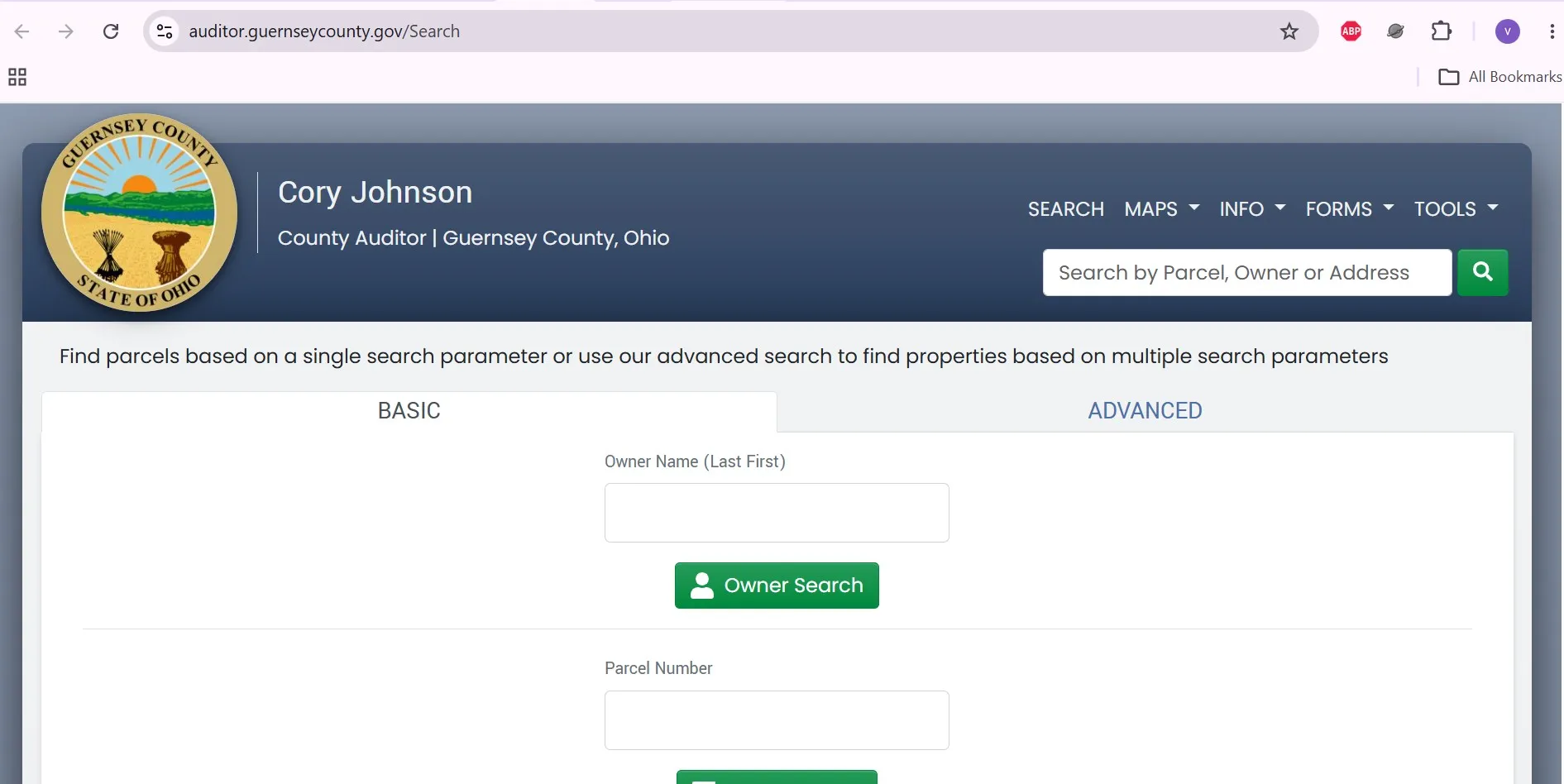
After preparing one clean search value, open the official Auditor search. The Basic tab is best for a known property; the Advanced tab is designed for multi-property research.
Choose the property problem you need to solve
This page is organised around user actions rather than a directory of unexplained links.
Which Guernsey County office handles your task?
What you need |
Use |
What it provides |
Important limit |
|---|---|---|---|
Owner, parcel, address, value or buildings |
Auditor Search |
Parcel, appraisal, land, building, sale and tax information. |
The displayed owner is not a title opinion. |
Mobile-home registration, park or lot |
Auditor Mobile Home Search |
Registration, park, lot, year, make, serial and assessed value. |
A mobile home may be taxed separately or affixed to real estate. |
Tax amount, payment or receipt |
Treasurer |
Balance, payments, delinquency, prepayment and collection help. |
The Auditor calculates but does not collect the payment. |
Parcel map, tax map or road map |
Auditor GIS / Map Department |
Parcel viewer, tax maps, road maps, property data and planning resources. |
Online boundaries are not a professional survey. |
Recorded plat or new survey |
Map Department |
Recorded plats, survey review, conveyance standards and split resources. |
Confirm that the correct cabinet, page or survey is being used. |
Deed, mortgage, lien or mineral instrument |
Recorder |
Official recorded land and document records. |
An online index is not a complete title examination. |
Challenge market value |
Board of Revision |
Formal DTE 1 complaint and evidence review. |
The Board may raise, lower or retain the value. |
Homestead, owner occupancy or CAUV |
Auditor |
Applications, income addenda, disability forms and CAUV resources. |
Each program has separate eligibility and deadlines. |
Search Guernsey County property records correctly
Prepare the most reliable search detail
- Enter the surname first.
- Add the first name only if the list is too broad.
- Use Last Name First order.
- Remove punctuation, initials or suffixes if needed.
- Try a trust, estate, company or former owner.
- Copy the number from a bill, deed or prior record.
- Enter the complete number first.
- If it fails, try the meaningful leading portion.
- Check zero versus the letter O.
- Verify the resulting address.
- Enter the house number separately.
- Enter only the main street name.
- Add N, S, E or W only when necessary.
- Select the abbreviated street type.
- Remove extra detail when no result appears.
- Use the registration number when known.
- Or select the mobile-home park.
- Add the lot number to narrow the match.
- Open the record and verify the serial number.
- Check whether it is separately taxed.
Open and save the correct result
After understanding the fields and search order above, open the official search. Do not use a paid third-party property site when the county search already provides the live parcel data.
Use Advanced Search without creating false matches
Advanced Search is designed to find groups of properties. It is useful for sales comparisons, neighbourhood research, farm searches and residential filters—not as the first step for one known parcel.
Filter group |
Available criteria |
Useful for |
Mistake to avoid |
|---|---|---|---|
Sales |
Sale dates, price range, buyer, seller and valid-sale status. |
Finding recent transactions and possible comparable sales. |
Treating every transfer as an arm’s-length sale. |
Location |
Tax district, township, school district and neighbourhood. |
Keeping comparisons within a similar local market. |
Using a mailing city as the only jurisdiction clue. |
Land |
Property class and acreage range. |
Separating farms, vacant land, mineral interests and residential tracts. |
Comparing a CAUV farm with ordinary development land. |
Residential |
Year built, living area, bedrooms and bathrooms. |
Finding physically similar homes. |
Adding so many filters that no property can qualify. |
Build a useful advanced search
No property result found?
Prepare this before calling the Auditor
Understand the parcel report before using it
Field |
What it means |
What to check next |
|---|---|---|
Parcel number |
The county identifier assigned to the taxable parcel. |
Use it for tax, map, deed, form and office questions. |
Owner |
The ownership name currently displayed in the Auditor database. |
Use the recorded deed for legal ownership verification. |
Property address |
The situs or physical location associated with the parcel. |
Compare it with the GIS map and road location. |
Mailing address |
The address used for tax or ownership correspondence. |
Do not confuse it with the physical property. |
Appraised value |
The Auditor’s estimate of market value. |
Compare property facts and valid sales before challenging it. |
Assessed value |
Generally 35% of appraised value in Ohio. |
Use the parcel’s tax district and credits when estimating taxes. |
Land value and class |
The acreage, use and value assigned to land. |
Check CAUV, mineral, timber, commercial or residential classification. |
Building value |
The value assigned to houses and other improvements. |
Review year built, living area, condition, grade and outbuildings. |
Transfer or sale |
The recorded transaction associated with the parcel. |
Check valid-sale status and the recorded instrument. |
Tax district |
The township, municipality, school and levy combination applying to the parcel. |
Use the same district in the official Tax Estimator. |
Inflation cap credit |
A separate credit that may appear in the 2025 tax calculation payable in 2026. |
Review the parcel’s second-half tax details rather than assuming both halves match. |
CAUV recoupment |
A charge connected with withdrawal or loss of agricultural-use qualification. |
Contact the Auditor before transferring or changing farm use. |
Check these physical facts before questioning value
- Land acreage and property class
- Year built and effective condition
- Living area and finished space
- Bedrooms and bathrooms
- Garages, barns and other improvements
- Mobile-home year, make and serial number
- Current photographs
- Measurements or plans
- Permit or demolition records
- Inspection or damage reports
- Survey, deed or recorded plat
- Comparable-property records
Check Guernsey County tax dates and payment fees
Past due date.
Verify the live amount before paying.
Past due date.
Confirm registration and balance.
Search the Treasurer record
Published payment costs and office options
Option |
Published detail |
Practical warning |
|---|---|---|
Debit or credit card |
2.45% additional fee. |
Review the exact fee before authorising a large payment. |
E-check |
$2 additional fee. |
Double-check the routing and account numbers. |
In person |
Suite 201, Monday–Friday, 8:00 a.m.–4:00 p.m. |
Check the county holiday schedule before travelling. |
Drive-up window |
Available through the Treasurer’s office. |
Bring the parcel or property number and confirm accepted payment methods. |
Night drop box |
Available at the Administration Building. |
Use a clearly identified envelope and do not leave cash. |
Prepayment or delinquent plan |
The Treasurer may arrange plans under Ohio law. |
Contact the office for a written schedule and current conditions. |
After identifying the property and reviewing the fees above, use the Treasurer’s official search. The county warns that electronic data can change and that original recorded documents should be used for legal transactions.
Use Guernsey County maps for the right purpose
- Updating county tax and road maps
- Checking deeds before transfer
- Receiving new surveys from registered surveyors
- Maintaining deed-reference abstract cards
- Reviewing land-development and split materials
- Assigning new house numbers and maintaining 911 addressing data
- Tax maps
- Recorded plats
- Historical atlas and plats
- Road maps
- USGS maps
- Watershed and cottage maps
Find a recorded plat
Find recent sales and meaningful comparisons
Use the official Advanced Search or sales reports to find transactions. A nearby parcel is not automatically comparable when its tax district, acreage, condition, land class or school district differs.
- Township or municipality
- Tax district
- School district
- Neighbourhood code
- Land property class
- Acreage
- Year built
- Living area and rooms
- Recent sale date
- Comparable price range
- Valid-sale status
- No unusual relationship or terms
Exclude misleading transfers
Find the recorded document behind the parcel
The Auditor record helps identify the parcel, owner and transfer. The Recorder controls the recorded deed, mortgage, lien, easement, release and mineral instrument.
Mineral deed and oil-or-gas interest questions
Guernsey County publishes a Mineral Deed Checklist, routing sheet and deed-transfer timeline. A surface parcel search may not fully explain a separately recorded coal, oil, gas or royalty interest.
After collecting the parcel and transfer clues, open the official Recorder page. For a mineral transfer, review the Auditor’s current forms before submitting a document.
Challenge an incorrect Guernsey County value
A Board of Revision complaint should explain why the market value is incorrect. The county warns that voter-approved levies have a major effect on taxes and that reducing all values would not necessarily produce an equivalent tax reduction.
Check the property record first
File DTE 1 correctly
Evidence matched to the problem
Issue |
Strong evidence |
Weak approach |
|---|---|---|
Recent purchase |
Closing statement, contract, deed and sale-condition documents. |
An unsupported online estimate. |
Incorrect building facts |
Measurements, photographs, plans, permits and demolition records. |
Saying only that the value feels too high. |
Poor condition or damage |
Dated photos, inspections, engineering reports and repair estimates. |
Ordinary maintenance complaints without cost evidence. |
Comparable sales |
Similar valid sales near the relevant valuation date. |
Selecting only the lowest sale prices. |
Farm or mineral property |
Use, acreage, CAUV status, soil or timber facts, buildings and interest type. |
Comparing mineral rights or CAUV land with ordinary residential land. |
Check property-tax credits and CAUV
Program |
Main purpose |
Important qualification |
Form or action |
|---|---|---|---|
Owner-Occupancy Reduction |
Reduction for a qualifying principal residence. |
The home must be owned and occupied as the primary residence. |
DTE 105C. |
Means-tested Homestead |
Tax relief for qualifying senior, disabled or surviving-spouse homeowners. |
Age, disability, principal residence and income rules may apply. |
DTE 105A with applicable addenda or disability certification. |
Veterans Homestead |
Enhanced relief for qualifying disabled veterans and eligible spouses. |
Specific service-connected disability requirements apply. |
DTE 105I. |
CAUV |
Values qualifying farmland according to current agricultural use. |
Generally 10 acres or more, or a qualifying $2,500 income route. |
DTE 109, $25 initial fee and annual renewal. |
Damaged property |
Requests value consideration after qualifying destruction or damage. |
The date, cause and extent of damage must be documented. |
DTE 26. |
Homestead income-year clarification
The county lists a $40,000 maximum household-income figure based on 2024 income for real-estate tax year 2025 collected in calendar year 2026.
The county lists a $41,000 maximum based on 2025 income for tax year 2026 collected in calendar year 2027.
CAUV eligibility and deadlines
- At least 10 acres in commercial agricultural use for the prior three years
- Or a smaller tract with average annual gross agricultural income of at least $2,500
- Land must be devoted exclusively to qualifying agricultural use
- A woodland management plan may be required when most acreage is wooded
- Apply January 1 through the first Monday in March
- Pay the $25 non-refundable initial fee
- Renew every year at no additional renewal cost
- Report a conveyance or change of use
- Understand possible recoupment after loss of qualification
After identifying the correct program, use the official forms page. Select Applications for Homestead and owner occupancy, CAUV/Agricultural District for farmland documents, or Real Estate for conveyance and damaged-property forms.
Prepare a deed transfer or parcel split
Guernsey County routes transferring documents through Recorder staff, the Map Department and the Auditor’s real-estate office. Documents that fail a conveyance or legal-description review can be rejected and restarted after correction.
Use the official calculators and standards
Contact the correct Guernsey County office
Office |
Use it for |
Contact |
Location and hours |
|---|---|---|---|
Auditor |
Search, values, tax calculations, credits, Homestead, CAUV and BOR. |
740-432-9243 Option 1: Real Estate |
627 Wheeling Ave., Suite 301, Cambridge, OH 43725 Monday–Friday, 8:00 a.m.–4:00 p.m. |
Treasurer |
Tax balance, payment, fees, delinquency, receipts and plans. |
627 Wheeling Ave., Suite 201, Cambridge, OH 43725 Monday–Friday, 8:00 a.m.–4:00 p.m. |
|
Map Department |
Tax maps, road maps, deed checking, surveys, recorded plats and splits. |
627 Wheeling Ave., Suite 303, Cambridge, OH 43725
|
|
Recorder |
Deeds, mortgages, liens, easements, releases and mineral records. |
Use the live official Recorder page for current staff, phone, search and copy instructions.
|
Confirm current office and recording hours before travelling.
|
Include this information in any call or email
Could the property be in a neighbouring county?
Rural mailing addresses and roads near county boundaries can point to a different Auditor. Confirm the county when repeated owner, address and map searches return no Guernsey County parcel.
Useful for parcels near the western boundary or properties connected with an East Muskingum school district or Zanesville-area mailing location.
Open Muskingum County property-search guideUseful for parcels near the northeastern Guernsey County boundary or a Cadiz-area record.
Open Harrison County property-search guideWhat online property records cannot prove
- Finding a parcel and public owner display
- Reviewing values, land and buildings
- Checking tax and sales information
- Locating maps, plats and forms
- Preparing questions for the correct office
- Legal title or mineral ownership
- Exact boundaries
- Buildability or zoning approval
- Unreleased liens and easements
- Purchase, lending or legal decisions
Guernsey County property search FAQs
How do I search Guernsey County property records by owner name?
Use the official Guernsey County Auditor search and enter the owner in Last Name First format. Begin with the surname only, add the first name if the results are too broad, and verify the parcel number and property location before relying on the record.
Can I search Guernsey County property by street address?
Yes. The official address search separates house number, direction, street name and street type. Begin with the house number and main street name, then add the direction or suffix only when necessary.
How do I search for a mobile home in Guernsey County?
Use the Mobile Home Search on the Auditor search page. Search with the registration number, park name or lot number. Verify the owner, park, lot, year manufactured, serial number and assessed value in the resulting record.
Why does a recently purchased property still show the former owner?
The recorded deed, Map Department transfer review and Auditor database may not update at the same moment. Search the former owner, review the transfer details and check the Recorder’s official records before assuming the deed was not recorded.
What is the difference between appraised and assessed value?
Appraised value is the Auditor’s estimate of market value. Ohio assessed value is generally 35 percent of appraised value and is used with effective tax rates, credits, reductions and special assessments to calculate the bill.
Are Guernsey County GIS parcel lines legally exact?
No. The GIS viewer and tax maps are useful for parcel research but do not replace a recorded deed, subdivision plat or professional boundary survey.
When are Guernsey County property taxes due in 2026?
The Guernsey County Treasurer lists February 27, 2026 as the first-half real-estate due date and July 31, 2026 as the second-half due date. Manufactured-home taxes were due March 31 and July 31, 2026.
How do I challenge a Guernsey County property value?
Review the parcel record, gather evidence and file the current DTE 1 complaint with the Guernsey County Board of Revision between January 1 and March 31. A hand-delivered complaint must reach Suite 301 by the published closing time on March 31.
How do I find a Guernsey County deed or mineral deed?
Use the Guernsey County Recorder for recorded deeds, mortgages, liens and mineral instruments. For a transfer involving mineral rights, also review the Auditor’s Mineral Deed Checklist, routing sheet and deed-transfer timeline.
Who should I call about a Guernsey County property-tax payment?
Call the Treasurer at 740-432-9278 for balances, payments, fees, delinquency, prepayment plans and receipts. Call the Auditor at 740-432-9243 and choose Option 1 for real-estate values, parcel records, tax calculations, Homestead, CAUV and Board of Revision questions.

Khushboo Bobade is the editor and digital publisher of CountyAuditors.org. She oversees the research and editorial process for the website, ensuring that information about county auditor offices, property records, and government resources is accurate, verified, and easy for visitors to understand.
10 Ohio Property Tax Calculators & Auditor Tools
Built specifically for Ohio's 35% assessment ratio, current DTE forms, and 2026 Homestead, Owner-Occupancy, CAUV, Conveyance Fee, and Board of Revision rules. Every number reflects verified Ohio Department of Taxation amounts.
Annual Tax Bill Estimator
OHIOApplies Ohio's 35% assessment ratio plus your county's effective millage tier — the actual math your auditor uses.
Homestead Reduction Calculator
DTE 105A2026 Ohio Homestead: $29,000 general or $58,000 enhanced (100% disabled vet, KIA spouse). OAGI under $41,000 required for non-veteran applicants.
Owner-Occupancy & Non-Business Credits
DTE 105CEvery Ohio owner-occupied home qualifies for the 2.5% Owner-Occupancy Credit plus the automatic 10% Non-Business Credit. Most owners don't realize these stack.
Conveyance Fee Calculator
ORC 322When you sell or transfer Ohio property, the auditor collects $1 state + up to $3 county per $1,000, plus $0.50 per parcel. Counties choose their rate.
CAUV Agricultural Savings
DTE 109Ohio's Current Agricultural Use Value cuts taxable value dramatically for farmland (10+ acres, or smaller with $2,500+ annual gross income).
Mill Rate Converter
Ohio tax rates appear three ways on auditor sites: mills, percent, or dollars per $1,000. Convert between them instantly.
Parcel Number Cleaner
Ohio's 88 counties each format parcels differently — Franklin uses 010-123456-00, Cuyahoga uses 001-23-456, Hamilton uses 100-0001-0001-00. Auto-detects.
35% Ratio Sanity Check
Ohio law sets taxable value at 35% of market value. If yours is significantly higher, you're a strong BOR appeal candidate.
BOR Appeal Savings
DTE 1A successful Board of Revision complaint typically cuts your value 10–20%. Filing is free and stays in effect until the next reappraisal.
BOR Deadline Countdown
MAR 31Ohio's statutory Board of Revision filing deadline is March 31 for the prior tax year. Miss it and you wait until next year — no extensions.
Verify with the official Ohio source
These calculators use the verified 2026 Ohio Department of Taxation amounts and statutory rules. For your exact bill, exemption status, and county-specific deadlines, always confirm with your county auditor and the Ohio Revised Code:
Estimates use Ohio's 35% statutory assessment ratio and effective tax rate tiers averaged across major Ohio counties. Your actual bill depends on local school levies, voted millage, inside vs. outside millage splits, House Bill 920 reduction factors (HB 920), and special assessments. The 2026 Homestead general amount ($29,000) and enhanced amount ($58,000) reflect HB 187 inflation indexing — your county auditor's office may show slightly different transitional figures. Nothing here is legal or tax advice. CountyAuditors.org is an independent informational directory, not affiliated with any county government.