Find a Parcel, Tax Record or Map
Search Shelby County property records by owner name, street address or parcel number, then open the parcel to review ownership, values, buildings, transfers, taxes, special assessments and where the property’s tax dollars are allocated.
This guide explains the disclaimer, what to type, how to verify the correct record, what every major field means, and when to use the Auditor, Treasurer, Recorder, GIS map or Board of Revision next.
Quick answer: how do you find a property?
Open the Shelby County Auditor Real Estate Search, accept the disclaimer, choose the Search tab, select an owner, address or parcel search, enter the simplest information you have, and verify the result using the parcel number plus the physical location.
Amy L. Berning
3rd Floor, Annex Building
Sidney, OH 45365
Monday–Thursday: 8:30 a.m.–4:30 p.m.
Friday: 8:30 a.m.–noon.
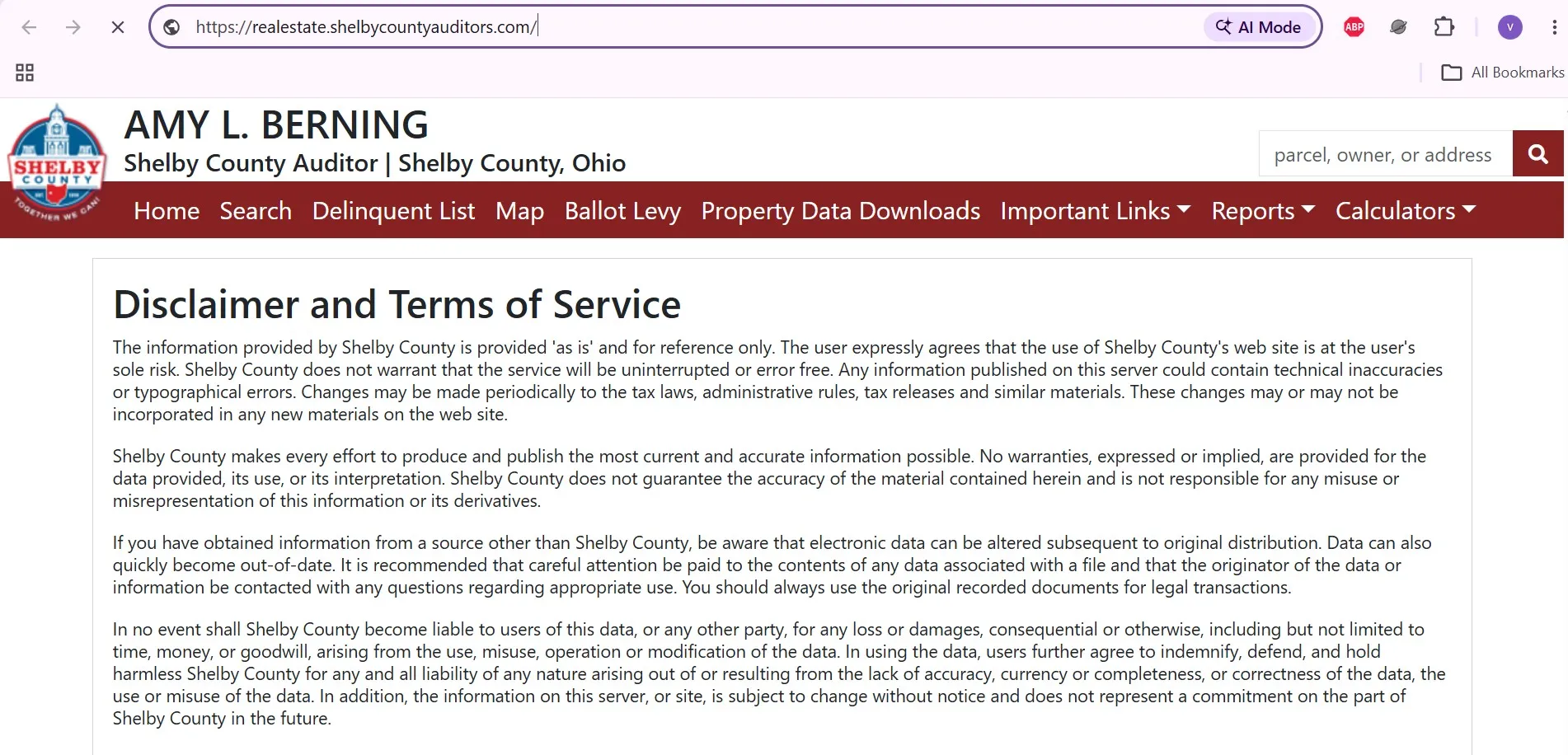
After preparing one search value, open the official property search. The site may redirect you to a disclaimer page. Read it, choose I AGREE, and continue to the requested search form.
Choose the property task you need
Use the relevant section instead of reading every detail from top to bottom.
Which Shelby County office handles your question?
Your task |
Use |
What it provides |
Important limit |
|---|---|---|---|
Find an owner, address, parcel or value |
Auditor Real Estate Search |
Ownership display, property facts, values, transfers, taxes and levy allocation. |
The online owner display is not legal proof of title. |
View the parcel location |
Auditor Map |
Parcel context, roads, aerial imagery and available map layers. |
The parcel line is not a legal survey. |
Compare sales or neighbourhoods |
Sales and Neighbourhood Reports |
Filtered sale information and neighbourhood-level property analysis. |
Not every transfer is a normal market sale. |
Estimate property taxes |
Auditor Tax Estimator |
Planning estimate based on selected property and tax assumptions. |
The estimate is not the Treasurer’s final bill. |
Pay taxes or check a balance |
Treasurer |
Online payment, posting, receipt, escrow and delinquency help. |
The Auditor does not collect the payment. |
Find a deed, mortgage or lien |
Recorder |
Recorded-document indexes, images, copy requests and FraudSleuth. |
Public searching is not a professional title examination. |
Challenge the value |
Board of Revision |
DTE 1 complaint, evidence review and hearing process. |
The Board does not change the tax rate or CAUV formula. |
Apply for property-tax relief |
Auditor |
Owner occupancy, Homestead, CAUV and damaged-property forms. |
Each programme has separate eligibility and filing rules. |
Search Shelby County property records step by step
Prepare one clean search detail
- Enter the surname first.
- Add the first name only if results are too broad.
- Remove initials, punctuation and suffixes if nothing appears.
- Try a trust, estate, LLC or business name where relevant.
- Search the former owner after a recent transfer.
- Enter the house number.
- Add the main street word.
- Leave off North, South, East or West initially.
- Remove Road, Street, Avenue and unit information if needed.
- Check the map when a rural address is unclear.
- Copy the number from a bill, deed or old property card.
- Enter the complete identifier.
- Remove separators only if the search fails.
- Check zero versus the letter O.
- Verify the resulting property location.
Open and verify the property
Save these details from the result
After following the steps above, use the official search. The county also allows searching from within its ArcGIS Map when a rural address or parcel location is easier to identify visually.
No Shelby County property result found?
Prepare this before calling the Auditor
Understand the Shelby County parcel record
Field |
What it means |
What to do next |
|---|---|---|
Parcel number |
The county’s identifier for the taxable parcel. |
Use it for taxes, maps, deeds, forms and office calls. |
Owner |
The ownership name currently displayed in the Auditor system. |
Use the recorded deed when legal ownership proof is required. |
Property address |
The physical or situs location linked to the parcel. |
Compare it with the parcel map and road location. |
Mailing address |
The address used for ownership or tax correspondence. |
Do not confuse it with the physical property. |
Market value |
The Auditor’s estimate of open-market property value. |
Review property facts and recent valid sales before appealing. |
Assessed value |
The taxable valuation used with Ohio property-tax rates. |
Do not compare taxes without checking the tax district and reductions. |
Land and improvements |
The separate property-value components for land and buildings. |
Verify acreage, square footage, condition and outbuildings. |
Transfer information |
The sale or ownership-transfer history associated with the parcel. |
Check the Recorder for the actual recorded instrument. |
Special assessments |
Separate charges that can appear in addition to ordinary property tax. |
Identify the assessment before filing a value complaint. |
Levy Distribution |
A breakdown showing how property-tax dollars are allocated. |
Use it to identify schools, township, county and other taxing recipients. |
Check property facts before disputing value
Use the parcel map without treating it as a survey
- Locating rural parcels
- Checking nearby parcels
- Comparing aerial context
- Understanding road access
- Finding a likely parcel number
- Exact property corners
- Marketable title
- Legal access rights
- Buildable area or setbacks
- Whether an encroachment exists
Use Sales and Neighbourhood Reports correctly
Sales Report workflow
What makes a stronger comparable sale?
After choosing your date, property type and location, use the official Sales Report. Accept the disclaimer before opening the report.
Check Shelby County tax deadlines, penalties and fees
The county moves a weekend date to the following Monday.
An August 3 USPS postmark is accepted as timely.
Failure to receive a bill does not remove the obligation.
Online payment fees and options
Method |
What to prepare |
Published fee or rule |
Practical warning |
|---|---|---|---|
Credit or debit card |
Name, address or parcel search plus card details. |
2.5% service fee; $2 published minimum. |
Review the final fee before authorising a large payment. |
eCheck |
Bank routing and account numbers. |
$1.30 flat service fee. |
Verify every digit before submitting. |
Automated phone |
Parcel or bill information and payment details. |
Call 844-537-0500. |
Save the confirmation number. |
Mail |
Payment and identifying bill information. |
Use a timely USPS postmark. |
Mail early and retain proof. |
Drop box |
Securely identified payment envelope. |
Main Street side of the Annex near the employee entrance. |
Do not leave cash in the drop box. |
Automatic debit or monthly prepay |
Authorisation form and bank information. |
County states no convenience fee for its debit option. |
Confirm the first withdrawal date and amount. |
Micro steps for paying online
Bill missing or taxes delinquent
Use Levy Distribution to explain the bill
After opening a parcel, use the left-side record tabs and select Levy Distribution. This feature shows how the parcel’s tax dollars are allocated among applicable taxing entities and levies.
- School-system allocations
- County-wide services
- Township or municipal shares
- Library, park or other district amounts
- Two nearby bills differ
- A levy changed
- You need a tax-dollar breakdown
- You are reviewing a ballot levy
- Every increase came from value
- Every nearby parcel has the same district
- Special assessments are ordinary tax
- An estimator is the final bill
The Tax Estimator can help with planning, but use the actual parcel record and Treasurer bill for final amounts.
Find deeds, mortgages, liens and easements
Use the Auditor record to identify the parcel, owner and transfer. Use the Recorder for the actual deed, mortgage, release, lien, easement or other recorded document.
Jodi Siegel
2nd Floor, Annex
Sidney, OH 45365
Monday–Thursday: 4:15 p.m.
Friday: 11:45 a.m.
After collecting the owner and transfer details, use the Recorder page and then open its official CountyFusion search.
Challenge an incorrect property value
File a Board of Revision complaint when the dispute concerns the parcel’s valuation or another matter within the Board’s authority—not simply because the total bill or tax rate feels high.
Check the property record first
File the complaint correctly
Evidence matched to the problem
Issue |
Useful evidence |
Weak approach to avoid |
|---|---|---|
Recent purchase |
Closing statement, purchase contract, deed and sale-condition details. |
Providing only an online estimate. |
Incorrect building facts |
Measurements, photographs, floor plans and permits. |
Saying the record is wrong without identifying the field. |
Poor condition or damage |
Dated photos, inspection reports and repair estimates. |
Listing ordinary maintenance items without value evidence. |
Comparable-sales argument |
Recent, similar, arm’s-length local sales. |
Selecting only the lowest nearby sale prices. |
Check owner occupancy, Homestead and CAUV
Programme |
Main purpose |
Important requirement |
Action |
|---|---|---|---|
Owner Occupancy |
A 2.5% reduction on taxes charged by qualifying levies. |
The home must be an eligible owner-occupied residence. |
Use DTE 105C. |
Homestead |
Reduces tax for qualifying seniors, disabled persons, veterans or surviving spouses. |
Principal residence, ownership and applicable income or status rules. |
Use DTE 105A, DTE 105I or related form. |
CAUV |
Values qualifying farmland according to agricultural use rather than ordinary market value. |
Agricultural-use and acreage or income requirements apply. |
Use DTE 109 and maintain annual eligibility. |
Damaged Property |
Requests value consideration after qualifying damage or demolition. |
Document the date, cause and extent of the damage. |
Use the current damaged-property form. |
Homestead details for 2026
Shelby County says qualifying senior, disabled and surviving-spouse applicants may receive a credit based on up to $29,000 of true market value in 2026. Qualifying disabled veterans and their surviving spouses may receive the enhanced credit based on up to $58,000.
CAUV preparation
After identifying the programme that applies, use Shelby County’s official forms. Do not reuse an old PDF from another county because local instructions and state forms can change.
Prepare for a deed transfer or parcel change
Shelby County publishes real-estate transfer fees of $4 per $1,000 of the sale price plus $0.50 per parcel. The Auditor also provides a Conveyance Fee Calculator, but the final filing can involve the Auditor, Recorder and other review staff.
After preparing the sale price, parcel count and transfer details, use the official Conveyance Fee Calculator for an estimate and confirm the filing documents with the county.
Contact the correct Shelby County property office
Office |
Use it for |
Contact |
Address and hours |
|---|---|---|---|
Auditor |
Search, value, calculations, Homestead, owner occupancy, CAUV and BOR. |
129 E. Court St., 3rd Floor, Sidney, OH 45365 Mon–Thu 8:30–4:30; Fri 8:30–noon |
|
Real Estate staff |
Parcel-search and real-estate record questions. |
Auditor office, Annex Building, third floor. |
|
Treasurer |
Payments, balances, receipts, prepay, delinquency and contracts. |
129 E. Court St., 3rd Floor, Sidney, OH 45365 Mon–Thu 8:30–4:30; Fri 8:30–noon |
|
Recorder |
Deeds, mortgages, liens, easements, recording and copies. |
129 E. Court St., 2nd Floor, Sidney, OH 45365 Mon–Thu 8:30–4:30; Fri 8:30–noon |
|
CAUV / Agricultural District |
Farmland valuation and agricultural-program questions. |
Auditor office. |
|
Board of Revision |
Complaint forms and filing questions. |
Auditor office; complaints accepted during the annual filing window. |
Could the property be in Miami County?
Shelby County’s official search lists Miami County as a surrounding county. A parcel near the southern boundary or a confusing mailing address may be recorded there instead.
Use this related guide when a Shelby County owner, address and map search still return no plausible parcel near the county line.
Open Miami County Auditor property-search guideWhat the online property search cannot prove
- Finding parcels and owner displays
- Reviewing value and property facts
- Checking sales and taxes
- Finding the correct map or office
- Preparing forms and questions
- Legal ownership and title
- Exact boundary locations
- Unreleased liens or easements
- Construction and zoning approval
- Purchase and lending decisions
Shelby County property search FAQs
Where can I search Shelby County Ohio property records?
Use the official Shelby County Auditor Real Estate Search. Accept the disclaimer, choose the Search tab and search by owner name, property address or parcel number.
How do I search Shelby County property by owner name?
Begin with the owner’s surname or one distinctive word from a trust, estate or business name. Add a first name or another detail only when the result list is too broad.
Why is a recently purchased property still listed under the former owner?
The recorded deed and Auditor property display may update at different times. Search the former owner and check the Shelby County Recorder’s official index before assuming that the deed was not recorded.
What information is available in a Shelby County parcel record?
A parcel record may show ownership, addresses, land and building details, market and assessed values, transfers, tax information, special assessments, maps and Levy Distribution information.
Are Shelby County GIS parcel lines legal boundaries?
No. Online parcel lines are useful for locating property but do not replace a recorded deed, subdivision plat or professional boundary survey.
When are Shelby County real-estate taxes due in 2026?
Shelby County’s current official notice lists August 3, 2026 as the second-half real-estate tax deadline. The county accepts an August 3 United States Postal Service postmark as timely.
How can I pay Shelby County property taxes online?
Use the official Treasurer payment page. Search the bill by name, address or parcel number, verify the parcel and balance, choose card or eCheck, review the service fee and save the confirmation number.
How do I find a Shelby County deed or mortgage?
Use the Shelby County Recorder’s online CountyFusion index. Online index coverage begins July 1, 1989. Earlier records may require an office visit or copy request.
How do I challenge a Shelby County property value?
Review the parcel facts, collect evidence and file the current DTE 1 complaint with the Shelby County Board of Revision between January 1 and March 31 for the applicable filing year.
Who should I call about a Shelby County tax-payment problem?
Call the Shelby County Treasurer at 937-498-7281 for payments, balances, receipts, escrow or delinquency. Call the Auditor at 937-498-7202 for values, parcel records, tax calculations, Homestead, owner occupancy and CAUV.

Khushboo Bobade is the editor and digital publisher of CountyAuditors.org. She oversees the research and editorial process for the website, ensuring that information about county auditor offices, property records, and government resources is accurate, verified, and easy for visitors to understand.
10 Ohio Property Tax Calculators & Auditor Tools
Built specifically for Ohio's 35% assessment ratio, current DTE forms, and 2026 Homestead, Owner-Occupancy, CAUV, Conveyance Fee, and Board of Revision rules. Every number reflects verified Ohio Department of Taxation amounts.
Annual Tax Bill Estimator
OHIOApplies Ohio's 35% assessment ratio plus your county's effective millage tier — the actual math your auditor uses.
Homestead Reduction Calculator
DTE 105A2026 Ohio Homestead: $29,000 general or $58,000 enhanced (100% disabled vet, KIA spouse). OAGI under $41,000 required for non-veteran applicants.
Owner-Occupancy & Non-Business Credits
DTE 105CEvery Ohio owner-occupied home qualifies for the 2.5% Owner-Occupancy Credit plus the automatic 10% Non-Business Credit. Most owners don't realize these stack.
Conveyance Fee Calculator
ORC 322When you sell or transfer Ohio property, the auditor collects $1 state + up to $3 county per $1,000, plus $0.50 per parcel. Counties choose their rate.
CAUV Agricultural Savings
DTE 109Ohio's Current Agricultural Use Value cuts taxable value dramatically for farmland (10+ acres, or smaller with $2,500+ annual gross income).
Mill Rate Converter
Ohio tax rates appear three ways on auditor sites: mills, percent, or dollars per $1,000. Convert between them instantly.
Parcel Number Cleaner
Ohio's 88 counties each format parcels differently — Franklin uses 010-123456-00, Cuyahoga uses 001-23-456, Hamilton uses 100-0001-0001-00. Auto-detects.
35% Ratio Sanity Check
Ohio law sets taxable value at 35% of market value. If yours is significantly higher, you're a strong BOR appeal candidate.
BOR Appeal Savings
DTE 1A successful Board of Revision complaint typically cuts your value 10–20%. Filing is free and stays in effect until the next reappraisal.
BOR Deadline Countdown
MAR 31Ohio's statutory Board of Revision filing deadline is March 31 for the prior tax year. Miss it and you wait until next year — no extensions.
Verify with the official Ohio source
These calculators use the verified 2026 Ohio Department of Taxation amounts and statutory rules. For your exact bill, exemption status, and county-specific deadlines, always confirm with your county auditor and the Ohio Revised Code:
Estimates use Ohio's 35% statutory assessment ratio and effective tax rate tiers averaged across major Ohio counties. Your actual bill depends on local school levies, voted millage, inside vs. outside millage splits, House Bill 920 reduction factors (HB 920), and special assessments. The 2026 Homestead general amount ($29,000) and enhanced amount ($58,000) reflect HB 187 inflation indexing — your county auditor's office may show slightly different transitional figures. Nothing here is legal or tax advice. CountyAuditors.org is an independent informational directory, not affiliated with any county government.