Find Parcels, Values, Tax Bills & Boundary Maps
Search Brown County property records by owner name, street address or property number, then use the result to review ownership, market and assessed values, acreage, land use, building details, transfers and tax information.
This guide explains exactly what to enter, how to fix a failed search, how to interpret the property card, where to check the delayed 2026 tax bill, and when to use the Auditor, Treasurer, Recorder, Engineer, GIS or Board of Revision.
Quick answer: where should you begin?
Use the official Brown County Auditor Real Estate Search. Choose Owner, Location or Number, enter the least amount of information that can identify the property, open the matching result, and save the property number before moving to tax payment, GIS, deed or valuation tasks.
Toll-free: 888-244-6420
Suite 181
Georgetown, OH 45121
7:30 a.m.–4:00 p.m.
Monday–Friday
Which Brown County office handles your task?
Your task |
Correct office or tool |
What it provides |
Important limit |
|---|---|---|---|
Find owner, parcel, value or building facts |
Auditor Real Estate Search |
Property number, owner display, location, land use, acreage, value, transfers and property details. |
The owner display does not replace the recorded deed. |
Check or pay a property-tax bill |
Treasurer |
Current bills, due dates, payment posting, online payment, escrow and delinquent plans. |
The Auditor calculates tax information but does not collect the payment. |
Find a deed, mortgage, lien or plat |
Recorder |
Recorded real-estate documents and subdivision plats. |
Online research does not provide a title opinion. |
View parcel boundaries or aerial context |
Brown County GIS |
Interactive maps, general map, mobile map, flood, soil, tax-map and historical resources. |
GIS boundaries are spatial references, not surveyed legal lines. |
Review a legal description or lot split |
Engineer / Tax Map Department |
Tax-map maintenance, deed review, land-transfer and lot-split mapping help. |
A GIS printout is not a legal description. |
Challenge the property value |
Board of Revision / Auditor |
DTE 1 complaint processing and value-review administration. |
A complaint addresses value, not dissatisfaction with a tax levy. |
Apply for tax relief |
Auditor |
Owner occupancy, Homestead, CAUV and damaged-property forms. |
Each programme has separate eligibility and filing rules. |
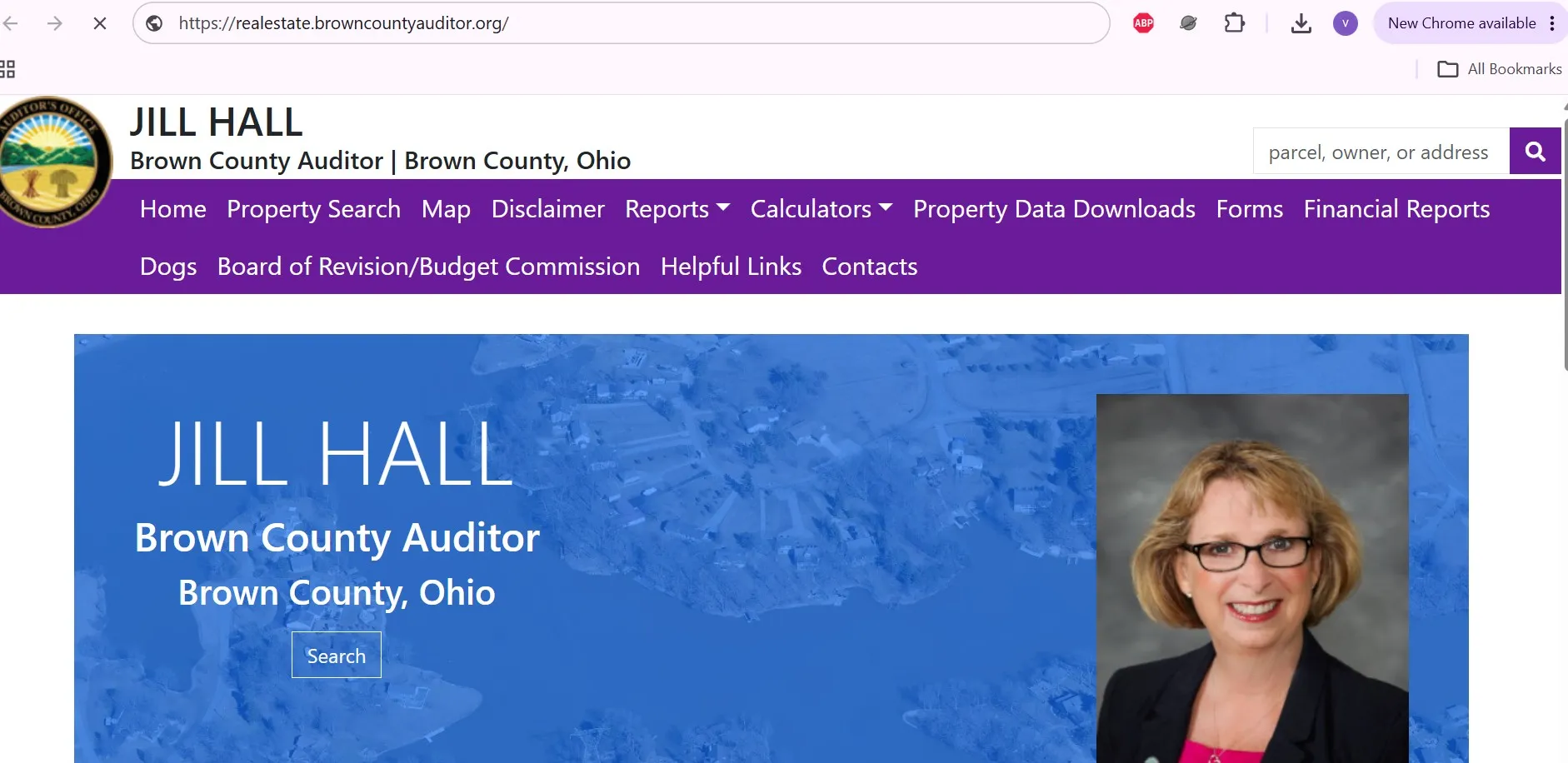
What to click on the Brown County search page
The official interface separates owner, location and property-number searches. Use only one search method initially. Including too many details can prevent a correct record from appearing.
Use the screenshot in this order
After following the screenshot guide, use the official live search for the current record.
Search Brown County property records correctly
- Choose Owner.
- Enter only the last name.
- Leave first and middle names blank initially.
- Add the first name only when too many records appear.
- Try a trust, estate, company or previous-owner name when relevant.
- Open the result and verify its location and property number.
- Choose Location.
- Enter the house number and main street word.
- Remove punctuation, unit details and directional letters initially.
- Try without Road, Street, Avenue or Highway.
- If necessary, place the house number in the street-name field.
- Verify the result using the owner and property number.
- Choose Number.
- Copy the number from a tax bill, deed or prior parcel record.
- Enter the complete identifier.
- If it fails, remove spaces or punctuation.
- Check zero versus the letter O.
- Confirm the displayed location before continuing.
Check Real Estate versus Manufactured Home
- Land and permanently assessed improvements
- Residential, agricultural, commercial or vacant parcels
- Parcel values, transfers and real-estate tax information
- Manufactured-home accounts maintained separately from real property
- Manufactured-home tax records
- Owner-occupancy and manufactured-home forms
Save these details from a correct result
No Brown County property result found?
Prepare this before calling
Understand the Brown County property card
Field |
What it means |
Practical next action |
|---|---|---|
Property number |
Brown County’s identifier for the property record. |
Use it for tax, GIS, deed, form and office questions. |
Owner |
The ownership name currently displayed in the Auditor database. |
Use the recorded deed when legal ownership proof is required. |
Location |
The physical address or descriptive property location. |
Do not confuse it with the owner’s mailing address. |
Tax district |
The local taxing jurisdictions assigned to the property. |
Use the correct district when reviewing tax rates or the estimator. |
Land use |
The recorded use or property classification. |
Contact Real Estate staff when the actual use is materially different. |
Acres |
The acreage maintained for appraisal and property-record purposes. |
Use a deed or survey for legal acreage and boundary questions. |
Appraised or market value |
The Auditor’s estimate of open-market real-property value. |
Check parcel facts and comparable valid sales before disputing it. |
Taxable or assessed value |
Ohio generally applies an assessment percentage of 35% to market value. |
Do not multiply it by a random countywide rate; tax districts differ. |
Transfer date and amount |
A sale or ownership-transfer record associated with the property. |
Review the transfer type before treating it as an open-market sale. |
Building details |
Recorded characteristics used in appraisal. |
Check area, age, condition, construction and outbuildings for errors. |
Check physical facts before questioning the value
- Living area and building footprint
- Year built and condition
- Basement and finished space
- Garages, barns and other improvements
- Land acreage and land use
- Real estate versus manufactured-home classification
- Current photographs
- Measurements or floor plans
- Permit or demolition documentation
- Contractor estimates
- Recorded deed or survey
- Damage reports
Check Brown County tax bills, dates and payment fees
Brown County delayed second-half real-estate bills while applying the Ohio House Bill 186 inflation-cap credit. The credit applies retroactively to tax year 2025 real property and tax year 2026 manufactured homes and may reduce the second-half amount.
This deadline has passed.
Confirm the live bill before payment.
Look for this wording on an affected bill.
Brown County payment methods and charges
Method |
What to prepare |
Published fee or rule |
Practical warning |
|---|---|---|---|
Electronic check |
Routing number, bank account and property/account number. |
$1.50 third-party processing fee. |
Check every banking digit before submission. |
Debit card |
Property/account number and debit card. |
1% third-party processing fee. |
Review the final charge before approval. |
Credit card |
Property/account number and credit card. |
2.45% third-party processing fee. |
The fee can be significant on a large bill. |
Pay by phone |
Property or account number and payment details. |
Call 1-833-610-5712; fees apply. |
Keep the confirmation number. |
Treasurer counter |
Current bill or property/account number. |
Cash, cheque or money order only. |
Cards are handled through the third-party online service. |
Front drop box |
Cheque or money order with parcel/account information. |
Must be deposited by 4:00 p.m. on the due date. |
Do not place cash in the drop box. |
Participating local bank |
Current real-estate tax bill. |
Billed amount only; no partial payment at banks. |
Bank hours control the due-date cut-off. |
Micro steps for a safe online payment
Missing bill, escrow or delinquent balance
After verifying the property and understanding the fees above, open the Treasurer’s official pages.
Use Brown County GIS without mistaking it for a survey
Brown County GIS is operated through the Engineer’s Office. Its map collection includes a general map, mobile map, flood maps, soil map, Board of Elections map, tax-map data, map archives, road-dedication plats, military surveys and an 1876 atlas.
How to locate a parcel on the map
Resource |
Useful for |
Do not use it alone for |
|---|---|---|
General Map |
Locating parcels, roads and surrounding properties. |
Exact boundary placement. |
Mobile Map |
Field reference and basic parcel research on a phone. |
Survey-grade measurements. |
Flood Maps |
Initial flood-area research. |
A final lender, insurance or regulatory determination. |
Soils Map |
Agricultural and preliminary land-characteristic research. |
Engineering, septic or construction approval. |
Tax Map Archive |
Historical parcel configuration and tax-map research. |
Proof of current legal ownership. |
Road Dedication Plats |
Researching recorded road-dedication documents. |
A complete title search. |
Military Surveys / 1876 Atlas |
Historical and genealogical land research. |
Current parcel or tax conclusions. |
Fence, building or boundary dispute
After identifying the property and understanding the map limitation, open Brown County’s official GIS site or contact the Engineer and Tax Map Department.
Search property sales and estimate taxes
Brown County provides a detailed Sales Search rather than only a simple transfer list. Users can filter by tax year, sale amount, sale date, year built, living area, stories, bedrooms, acreage, land use, tax district, school district and valid-sale status.
Build a useful comparable-sales search
- Same or similar tax district
- Same school district when possible
- Nearby township, village or rural setting
- Similar road access and surrounding use
- Similar land use
- Living area and number of stories
- Year built and condition
- Bedrooms, acreage and improvements
- Recent sale date
- Similar sale range
- Valid-sale selection
- No unusual family or forced-sale circumstances
Exclude misleading transfers
Use the tax estimator carefully
The Auditor’s estimator asks for property class, tax district and appraised value and includes an owner-occupancy option. Use the district shown on the property record. Treat the output as an estimate and compare it with the parcel’s live Treasurer bill before budgeting or closing.
Once you know the filters you need, use the official tools below.
Find deeds, mortgages, liens and subdivision plats
Use the Brown County Recorder when you need the actual recorded legal document. The Auditor’s owner display and transfer information help identify the record but do not replace it.
Move from the Auditor result to the Recorder
Document |
What it may show |
Why users need it |
|---|---|---|
Deed |
Grantor, grantee, legal description and recording information. |
Ownership and transfer research. |
Mortgage |
Borrower, lender and recorded security interest. |
Loan and title research. |
Release or satisfaction |
Recorded release of an earlier mortgage or lien. |
Checking whether an obligation was formally cleared. |
Lien |
A recorded claim associated with a person or property. |
Pre-purchase and ownership research. |
Easement |
Recorded use rights affecting part of the land. |
Access, utility and development questions. |
Subdivision plat |
Lots, streets, dimensions and recorded subdivision details. |
Lot and boundary-document research. |
The county government page confirms that the Recorder maintains deeds, mortgages, liens and all subdivision plats. Use that page to reach the Recorder’s official website and online search.
Challenge an incorrect Brown County property value
A Board of Revision complaint concerns value. It is not a request to cancel a levy, remove a special assessment or reduce a bill solely because it is unaffordable.
Review the record before filing
Build an evidence packet
- Recent arm’s-length purchase documents
- Independent appraisal
- Comparable valid sales
- Photographs of material condition issues
- Repair estimates or professional reports
- Measurements or floor plans
- Demolition or permit records
- Recorded survey
- Deed or legal-description documents
- Evidence of incorrect property class or land use
Prepare the complaint step by step
Brown County lists Board of Revision staff separately from general real-estate questions. After preparing the information above, use the official forms and contact pages.
Check owner occupancy, Homestead and CAUV
Programme |
Main purpose |
Key qualification clue |
Common form |
|---|---|---|---|
Owner-Occupancy Credit |
Credit for qualifying owner-occupied residential property. |
The home must be the qualifying primary residence. |
DTE 105C; DTE 56 for certain manufactured homes. |
Homestead Exemption |
Additional relief for qualifying homeowners. |
Age, disability, income, veteran or surviving-spouse rules may apply. |
DTE 105A, 105I or another applicable Homestead form. |
CAUV |
Values qualifying agricultural land according to agricultural use. |
Agricultural-use, acreage, income and continuing-use rules apply. |
DTE 109 initial and DTE 109A renewal. |
Damaged Property |
Requests valuation relief after qualifying destruction or damage. |
The date, cause and extent of damage must be documented. |
DTE 26. |
Owner-Occupancy Credit
Use DTE 105C for a qualifying owner-occupied real-property residence. A rental, second home or investment property should not be treated as an owner-occupied primary residence.
Homestead Exemption
Brown County provides separate forms for senior citizens, disabled homeowners, disabled veterans and qualifying surviving spouses. Eligibility can depend on ownership, primary residence, age or disability status, income and the specific statutory category.
CAUV agricultural valuation
CAUV is not a general rural-property discount. The land must meet Ohio agricultural-use requirements. Initial and renewal applications are filed with the Auditor, and continued qualification matters because a change in use can create recoupment.
- Identify every property number
- Document qualifying agricultural use
- Prepare acreage and income information when applicable
- Use the current DTE 109
- File after the first Monday in January and before the first Monday in March
- File the annual DTE 109A renewal
- Report a qualifying transfer using DTE 102
- Keep agricultural-use documentation
- Ask about recoupment before changing use or withdrawing land
- Contact the Auditor when parcel boundaries change
Useful Brown County forms
Form |
Use it for |
Preparation reminder |
|---|---|---|
DTE 1 |
Complaint against real-property valuation. |
Confirm tax year and filing deadline. |
DTE 100 |
Real-property conveyance fee statement of value. |
Prepare consideration, parties and property information. |
DTE 100(EX) |
Statement explaining an exemption from conveyance fee. |
The transfer must meet a listed exemption reason. |
DTE 101 |
Conveyance of Homestead property. |
Use during an applicable ownership transfer. |
DTE 102 |
Conveyance of CAUV property. |
Ask about continued eligibility and recoupment. |
DTE 105C |
Owner-occupancy reduction application. |
Confirm primary-residence status. |
DTE 105A / 105I |
Homestead application for applicable categories. |
Prepare income, disability or veteran documentation as required. |
DTE 109 / 109A |
Initial CAUV application and annual renewal. |
File within the statutory agricultural-use window. |
DTE 26 |
Destroyed or damaged real-property application. |
Document the date, cause and physical damage. |
After identifying the correct programme and form, open Brown County’s current forms page.
Handle a property transfer or parcel split
Prepare these documents and details
Contact the correct Brown County property office
Office |
Use it for |
Phone and fax |
Address and hours |
|---|---|---|---|
Auditor — Jill Hall |
Property search, appraisal, tax calculations, CAUV, Homestead, owner occupancy, transfers and Board of Revision. |
800 Mt. Orab Pike, Suite 181 Georgetown, OH 45121 7:30 a.m.–4:00 p.m., Monday–Friday |
|
Treasurer — Traci Stamper |
Tax bills, payments, posting, escrow, instalment and delinquent-payment plans. |
800 Mt. Orab Pike, Suite 171 Georgetown, OH 45121 8:00 a.m.–4:00 p.m., Monday–Friday |
|
Recorder — Mariah Votel |
Deeds, mortgages, liens, easements, releases and subdivision plats. |
800 Mt. Orab Pike, Suite 151 Georgetown, OH 45121 8:00 a.m.–4:00 p.m., Monday–Friday |
|
Engineer — Todd Cluxton |
County engineering, road information and Engineer-office questions. |
25 Veterans Blvd. Georgetown, OH 45121 7:00 a.m.–5:00 p.m., Monday–Thursday |
|
Tax Map Department |
Auditor tax maps, deed review, land transfers and lot-split mapping. |
Phone: 937-378-3494
|
25 Veterans Blvd. Georgetown, OH 45121 8:00 a.m.–4:00 p.m., Monday–Friday |
Direct Auditor staff routing
Could the property be in a neighbouring county?
Mailing addresses and road names near county lines can cause repeated searches in the wrong jurisdiction. Confirm the county before assuming the Brown County record is missing.
Useful for properties near Brown County’s eastern boundary or West Union-area records.
Open the Adams County property-search guideUseful for properties near Brown County’s western boundary or Clermont-area mailing addresses.
Open the Clermont County property-search guideWhat online Brown County property records cannot prove
- Finding a property number and current owner display
- Reviewing values, land use and building facts
- Checking tax and transfer information
- Locating GIS, deed, form and sales resources
- Preparing questions for the correct county office
- Legal ownership and marketable title
- Exact boundaries and encroachments
- Building, zoning, septic or flood approval
- Unreleased liens and easements
- Purchase, lending or legal decisions
Brown County property search FAQs
How do I search Brown County property records by owner name?
Open the official Brown County Auditor real estate search, choose Owner, enter the last name first and leave the first and middle names blank initially. Add another name field only when the first search returns too many possible properties.
Why does my Brown County address search return no result?
Simplify the address by removing punctuation, directional letters, unit information and the street suffix. Brown County’s search help also warns that in some cases the house number must be entered with the street name rather than in the separate number field.
Can I search Brown County property records by parcel number?
Yes. Choose the Number search and enter the property number from a tax bill, deed, prior parcel card or other county document. Confirm the property location and owner before relying on the result.
Why were Brown County second-half 2026 property-tax bills delayed?
Brown County says the bills were delayed while Ohio House Bill 186’s inflation-cap credit was applied retroactively to tax year 2025 real property and tax year 2026 manufactured homes. The adjustment may reduce the second-half amount and appears on affected bills as an inflation cap credit.
When are Brown County second-half 2026 property taxes due?
The Brown County Treasurer lists July 31, 2026 as the second-half due date for both real estate and manufactured-home taxes. Property owners should confirm the live balance and payment posting with the Treasurer.
Are Brown County GIS property lines legally exact?
No. Brown County GIS states that parcel boundaries are provided as spatial references and are not considered correct until verified on-site by a qualified individual. Use a recorded survey and professional boundary verification when exact lines matter.
Where can I find a Brown County deed, mortgage or lien?
Use the Brown County Recorder, which maintains deeds, mortgages, liens and subdivision plats. Begin with the owner name, transfer date or document reference found in the Auditor property record.
How do I challenge a Brown County property value?
Review the parcel facts and recent comparable sales, gather evidence and file the current DTE 1 complaint with the Brown County Board of Revision during the applicable filing period. Confirm the current form, tax year and deadline with the Auditor before filing.
What is the difference between owner occupancy, Homestead and CAUV?
Owner occupancy is a credit for a qualifying primary residence, Homestead provides additional relief for eligible homeowners under age, disability, veteran, surviving-spouse and income rules, and CAUV provides agricultural-use valuation for qualifying farmland.
Who should I call about a Brown County property-tax payment problem?
Call the Brown County Treasurer at 937-378-6705 for tax bills, online payments, posting, escrow and delinquent-payment plans. Call the Auditor at 937-378-6398 for property values, parcel data, tax calculations, credits, exemptions and valuation complaints.

Khushboo Bobade is the editor and digital publisher of CountyAuditors.org. She oversees the research and editorial process for the website, ensuring that information about county auditor offices, property records, and government resources is accurate, verified, and easy for visitors to understand.
10 Ohio Property Tax Calculators & Auditor Tools
Built specifically for Ohio's 35% assessment ratio, current DTE forms, and 2026 Homestead, Owner-Occupancy, CAUV, Conveyance Fee, and Board of Revision rules. Every number reflects verified Ohio Department of Taxation amounts.
Annual Tax Bill Estimator
OHIOApplies Ohio's 35% assessment ratio plus your county's effective millage tier — the actual math your auditor uses.
Homestead Reduction Calculator
DTE 105A2026 Ohio Homestead: $29,000 general or $58,000 enhanced (100% disabled vet, KIA spouse). OAGI under $41,000 required for non-veteran applicants.
Owner-Occupancy & Non-Business Credits
DTE 105CEvery Ohio owner-occupied home qualifies for the 2.5% Owner-Occupancy Credit plus the automatic 10% Non-Business Credit. Most owners don't realize these stack.
Conveyance Fee Calculator
ORC 322When you sell or transfer Ohio property, the auditor collects $1 state + up to $3 county per $1,000, plus $0.50 per parcel. Counties choose their rate.
CAUV Agricultural Savings
DTE 109Ohio's Current Agricultural Use Value cuts taxable value dramatically for farmland (10+ acres, or smaller with $2,500+ annual gross income).
Mill Rate Converter
Ohio tax rates appear three ways on auditor sites: mills, percent, or dollars per $1,000. Convert between them instantly.
Parcel Number Cleaner
Ohio's 88 counties each format parcels differently — Franklin uses 010-123456-00, Cuyahoga uses 001-23-456, Hamilton uses 100-0001-0001-00. Auto-detects.
35% Ratio Sanity Check
Ohio law sets taxable value at 35% of market value. If yours is significantly higher, you're a strong BOR appeal candidate.
BOR Appeal Savings
DTE 1A successful Board of Revision complaint typically cuts your value 10–20%. Filing is free and stays in effect until the next reappraisal.
BOR Deadline Countdown
MAR 31Ohio's statutory Board of Revision filing deadline is March 31 for the prior tax year. Miss it and you wait until next year — no extensions.
Verify with the official Ohio source
These calculators use the verified 2026 Ohio Department of Taxation amounts and statutory rules. For your exact bill, exemption status, and county-specific deadlines, always confirm with your county auditor and the Ohio Revised Code:
Estimates use Ohio's 35% statutory assessment ratio and effective tax rate tiers averaged across major Ohio counties. Your actual bill depends on local school levies, voted millage, inside vs. outside millage splits, House Bill 920 reduction factors (HB 920), and special assessments. The 2026 Homestead general amount ($29,000) and enhanced amount ($58,000) reflect HB 187 inflation indexing — your county auditor's office may show slightly different transitional figures. Nothing here is legal or tax advice. CountyAuditors.org is an independent informational directory, not affiliated with any county government.