Find Parcels, Values, Taxes & Land Records
Search a Scioto County property by owner name, street address or parcel number, then review the property’s market value, taxable value, land, buildings, sales, tax district, tax history and map information.
This practical guide explains all six official search routes, what to enter, how to fix a missing result, how to understand the countywide value update, and when to move from the Auditor to the Treasurer, Recorder, Engineer/GIS or Board of Revision.
Quick answer: start with the Auditor portal
Use the official Scioto County Auditor portal for owner, address, parcel, sales and certified-delinquent searches. Start with one clean identifier, open the matching property, save the parcel number, and use that number when checking taxes, GIS boundaries, deeds, Homestead, CAUV or a value complaint.
Room 103
Portsmouth, OH 45662
Monday–Friday
8:00 a.m.–4:30 p.m.
Official Quick Search displayed an update date of July 15, 2026.
The search portal also offers registration and a portfolio feature for saving multiple parcels. This can help an owner, investor or professional return to the same properties without rebuilding every search.
Choose the property task you need to complete
This guide is arranged around user actions rather than a list of unexplained links.
Which Scioto County office handles your question?
Start with the Auditor when you need to identify a parcel or understand its valuation. Move to another office only when that office controls the final action.
What you need |
Correct office or tool |
What it provides |
Important limit |
|---|---|---|---|
Owner, address, parcel number or property value |
Auditor property search |
Ownership display, parcel details, values, sales, tax information and search routes. |
The owner display is not a legal title opinion. |
Tax balance, bill, due date or payment |
County Treasurer |
Tax collection, payment status, delinquency and payment processing. |
The Auditor identifies the parcel but does not collect the payment. |
Deed, mortgage, lien, easement or release |
County Recorder |
Recorded land documents, indexes, images and recording services. |
A public search is not a professional title examination. |
Parcel map, owner map or geographic context |
Engineer GIS system |
Interactive owner, address, parcel-number and boundary searches. |
GIS lines are not legal survey measurements. |
Survey, exact boundary or legal-description help |
Engineer / survey professional |
Mapping context, road and survey routing assistance. |
A licensed survey may be necessary for exact ground boundaries. |
Challenge the market value |
Board of Revision |
DTE 1 complaint review and valuation hearing process. |
BOR reviews value, not dislike of tax rates or levies. |
Homestead, Owner Occupancy or CAUV |
County Auditor |
Applications, eligibility review and agricultural valuation administration. |
Each program has different ownership, use, income or filing rules. |
Search by owner, address or parcel number
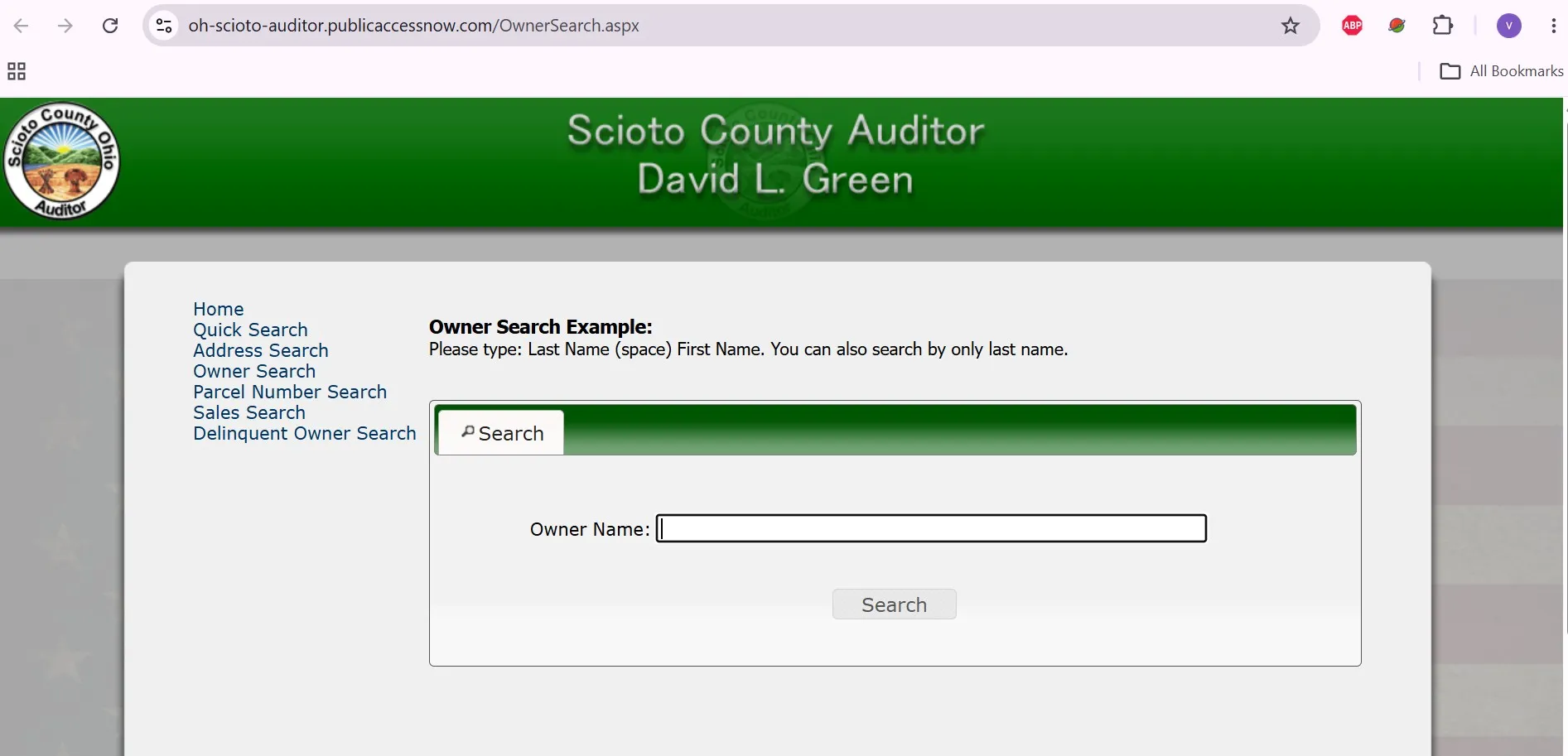
The dedicated search pages provide specific formatting instructions. Following those instructions can prevent a valid property from being excluded.
- Enter the name as Last Name First Name.
- Begin with the last name only.
- Add the first name if the results are too broad.
- Remove middle initials and suffixes if nothing appears.
- Try a trust, estate, company or former-owner name when relevant.
- Enter the house or property number.
- Enter the main street name.
- Leave out N, S, E or W.
- Leave out Street, Road, Drive, Avenue and similar suffixes.
- Use the House Number High field only for a number range.
- Copy the number from a tax bill, deed or earlier property record.
- Enter the complete parcel number first.
- Dashes and spaces are not required.
- Partial parcel-number entries are allowed.
- Confirm the address before using the result.
Open and verify the matching property
Save these details before leaving the record
After reviewing the formatting rules above, choose the official search page that matches the information you already have.
Choose Quick, Sales or Delinquent Owner Search
Search route |
Use it when |
Important input rule |
Best next action |
|---|---|---|---|
Quick Search |
You want a flexible starting point or do not know which dedicated search to use. |
Begin with one clean owner, address or parcel clue. |
Open the detailed result and copy the parcel number. |
Address Search |
You know the property location but not the owner or parcel ID. |
Omit street directions and suffixes during the first search. |
Verify the owner and tax district. |
Owner Search |
You know a person, company, trust or estate associated with the property. |
Use Last Name First Name or last name only. |
Distinguish same-name results by address and parcel number. |
Parcel Number Search |
You have a bill, deed, prior property card or partial parcel identifier. |
No dashes or spaces are required; partial entries are accepted. |
Confirm the property address before proceeding. |
Sales Search |
You are researching recent sales, comparable properties or a valuation question. |
Use price, date, year built, square footage, use code, style and tax district filters. |
Remove non-market or materially different transactions. |
Delinquent Owner Search |
You need records already flagged as certified delinquent. |
Enter Last Name First Name or last name only. |
Review the CertDlqYr field and verify the live amount with the Treasurer. |
No Scioto County property result found?
Try these fixes before assuming the property is not in the database.
Information to prepare before calling
Understand the Scioto County parcel record
A parcel record combines identification, appraisal, land, improvement, sale, tax and geographic information. Each field answers a different question.
Record field |
What it means |
What to check next |
|---|---|---|
Parcel number |
The county identifier assigned to the parcel record. |
Save it for Treasurer, Recorder, GIS, form and appeal questions. |
Owner name |
The ownership name displayed in the Auditor database. |
Check the recorded deed when legal ownership proof is required. |
Property address |
The location associated with the real estate. |
Do not confuse it with the owner’s tax-mailing address. |
Tax district |
The combination of county, township, municipal, school and other taxing jurisdictions. |
Use the same district when comparing tax rates or sales. |
Market value |
The Auditor’s estimate of full market value. |
Review property facts and valid recent sales before disputing it. |
Taxable or assessed value |
Ohio’s taxable listing value, generally 35% of full market value. |
Do not confuse this smaller figure with full market value. |
Land acreage and use code |
The recorded land size and appraisal-use category. |
Check acreage, agricultural use, homesite and mineral classifications. |
Building information |
Recorded size, style, age, grade, condition and improvements. |
Document major errors before requesting a correction. |
Sale date and amount |
A recorded transfer connected with the parcel. |
Check deed type and relationship before treating it as a market sale. |
Tax information |
Charges, credits, payments, delinquency and taxing detail. |
Verify the live amount and payment status with the Treasurer. |
GIS or map link |
A geographic display of the parcel and nearby features. |
Use a deed, plat and survey for exact legal-boundary work. |
Check these facts before questioning the value
- Living area and building footprint
- Year built and condition
- Building style and grade
- Basement and finished area
- Garage, barn and other improvements
- Acreage and land use
- Current photographs
- Measurements or floor plans
- Permit or demolition records
- Repair estimates
- Recorded deed or survey
- Damage documentation
Why Scioto County property values changed
The Auditor announced completion of the county’s regularly scheduled triennial update. The update uses sales information, market trends, statistical analysis and recognized appraisal standards rather than physically inspecting every property.
Average value increase, not a guaranteed increase for every parcel.
Acceptable assessment ratio referenced by the Auditor.
General assessed-value relationship to full market value.
Full reappraisal and update cycles are separate processes.
What influenced the update?
Market transactions help show whether existing values reflect current selling prices.
Appraisal analysis considers changes across neighborhoods, property types and use categories.
The Auditor reports that tentative values were submitted, rejected and resubmitted at levels sufficient for state approval.
Why a value increase and tax increase can differ
The tax bill also depends on assessed value, effective tax rates, reduction factors, Owner Occupancy, Homestead, CAUV, tax districts, voted levies, special assessments, delinquency and any applicable inflation-cap adjustment. A 20% market-value increase does not automatically create a 20% increase in the final amount due.
Review the parcel’s current value and Tax Year 2025 rate table before deciding whether the issue is value, district, credit, special assessment or payment status.
Check Scioto County taxes and possible bill adjustments
The Auditor warns that recent Ohio legislation created an inflation cap for certain property-value increases. Because the change could not be included in first-half bills, an eligible parcel’s second-half bill may be adjusted. Not every parcel qualifies.
Room 102
Portsmouth, OH 45662
Use the county-linked Treasurer site for the live account, payment and balance.
Prepare the parcel number before opening the payment system.
Micro steps to check and pay the tax bill
When the balance looks wrong
Use Sales Search to find better comparisons
The official Sales Search supports price, sale-date, year-built, square-footage, use-code, building-style and tax-district filters.
How to set the official sales filters
Filter |
Official input guidance |
Practical use |
|---|---|---|
Low / High Sale Price |
Enter a price range. |
Remove transactions far outside the subject property’s likely range. |
Begin / End Sale Date |
Enter dates as MM/DD/YEAR or use the calendar. |
Focus on sales near the relevant valuation date. |
Begin / End Year Built |
Enter an age range. |
Avoid comparing a newer home with a much older structure. |
Low / High Square Footage |
Enter a building-size range. |
Find properties with more similar living or building area. |
Use Code |
Hold CTRL while selecting multiple codes on a desktop keyboard. |
Separate residential, agricultural, commercial, industrial, exempt and mineral uses. |
Style |
Choose one or more building-style categories. |
Compare ranch, Cape Cod, bi-level, modular, multi-family and other styles more accurately. |
Tax District |
Choose the applicable township, village, Portsmouth ward and school-district combination. |
Improve both tax and location comparability. |
Exclude weak comparisons
Use Scioto County GIS without treating it as a survey
The Scioto County Engineer’s GIS system provides interactive property and geographic data. The county describes searches by owner, address, tax parcel number and boundaries.
Open the correct parcel in GIS
- Locating a parcel
- Finding nearby parcel numbers
- Understanding roads and geographic context
- Checking whether a result is in the expected area
- Preparing a survey or Engineer question
- Exact ground boundary location
- Legal ownership
- Absence of easements
- Permission to build
- Marketable title
Room 401
Portsmouth, OH 45662
Find deeds, mortgages, liens and easements
The Recorder maintains permanent records involving land conveyance and encumbrances. Use Recorder records when you need the recorded document rather than the Auditor’s current owner display.
Search the public records step by step
How a deed is prepared and recorded
Step or rule |
Official detail |
Practical meaning |
|---|---|---|
Draft a new deed |
A new transfer uses a new document rather than reusing the previous deed. |
Professional preparation is strongly recommended. |
Font and ink |
Legible font size 10 or larger in blue or black ink. |
Small, colored or unreadable text can prevent acceptance. |
Paper size |
8.5 × 11 or 8.5 × 14 inches. |
Do not submit an unusual page size. |
Highlighting |
Text should not be highlighted. |
Highlighting can reduce document-image quality. |
Side and bottom margins |
One-inch margins. |
Leave required recording space around the text. |
Top margin |
Three inches on page one and 1.5 inches on later pages. |
The Recorder needs space for official information. |
Legal description |
A legal description is required. |
Use the last recorded deed or professionally prepared description. |
Notary |
Transfers must be signed before a notary. |
An unsigned or improperly acknowledged deed cannot complete the process. |
Auditor first |
Property transfers and deed changes go to the Auditor before recording. |
Auditor transfer fees are separate from Recorder charges. |
Return envelope |
Mail filings should include a self-addressed stamped envelope. |
Otherwise the Recorder may charge return postage. |
Room 110
Portsmouth, OH 45662
Monday–Friday
8:00 a.m.–4:00 p.m.
The Recorder notes implementation of a $5 record-preservation fee.
Check Homestead, Owner Occupancy and CAUV
Program |
Main purpose |
Important eligibility clue |
Action |
|---|---|---|---|
Owner Occupancy |
Reduction for a qualifying principal residence. |
The property must meet principal-residence and filing requirements. |
Use the current Auditor application and later verify the credit on the tax record. |
Homestead Exemption |
Additional relief for qualifying homeowners. |
Age, disability, veteran, surviving-spouse, ownership, residence and income rules may apply. |
Use the application matching the applicant category. |
CAUV |
Values qualifying agricultural land according to agricultural use rather than development potential. |
The application must document qualifying use, acreage and income when applicable. |
File DTE 109 before the first Monday in March with the $25 initial fee. |
Destroyed or Damaged Property |
Requests a value deduction after qualifying physical destruction or damage. |
Deadlines and allowed percentages depend on the calendar quarter of damage. |
Use DTE 26 and document date, cause, damage and estimated value loss. |
Homestead eligibility basics
The Auditor states that an applicant may qualify by being at least 65 during the first filing year or by being permanently and totally disabled. Separate applications are available for eligible veterans and surviving spouses of public-service officers killed in the line of duty.
Surviving-spouse rule
The published Homestead guidance says an eligible surviving spouse may continue qualification when the deceased spouse had qualified and the surviving spouse was at least 59 but not yet 65 on the date of death, subject to the other requirements.
CAUV initial application
Submitted with DTE 109.
For the current tax year.
Received by the Auditor, not merely postmarked.
Potential tax-savings charge after disqualification or withdrawal.
What the CAUV form asks you to document
- Total qualifying acreage
- Land use during the last three years
- Current crop and land-use acreage
- Agricultural gross income for smaller acreage
- Commercial timber or woodland use
- Homesite acreage
- Road, waste and pond acreage
- Conservation-program contract and map
- Tenant farmer’s contact information
- Income evidence when requested
Destroyed or damaged property timing
Damage period |
Application deadline |
Maximum scheduled percentage |
|---|---|---|
January–March |
December 31 |
100% |
April–June |
December 31 |
75% |
July–September |
December 31 |
50% |
October–December |
January 31 of the following year |
25% |
After identifying the correct program, use the Auditor homepage form links. Do not reuse an old application saved from another county.
Challenge an incorrect Scioto County property value
Use Board of Revision when the dispute concerns the property’s full market value. Do not file only because the tax bill feels high; first separate value, tax-rate, credit, levy, special-assessment and payment issues.
Check for a correctable property-data error
Complete DTE 1 step by step
Important DTE 1 rules
Rule |
What it means |
Practical action |
|---|---|---|
Counter-complaint deadline |
Generally 30 days after notice of the original complaint. |
Act immediately after receiving notice. |
Multiple parcels |
Parcels generally need identical ownership and the same taxing district to share one complaint. |
Use separate complaints when those conditions are not met. |
Hearing notice |
The Board provides at least 10 days’ notice of the hearing. |
Keep contact details current and prepare evidence early. |
Value can move either way |
The Board may increase or decrease total land-and-building value. |
Review all available evidence before filing. |
Evidence preservation |
Evidence not presented to the Board may be restricted during a later appeal. |
Submit all relevant evidence you possess. |
Tendered tax payment |
An owner may tender tax based on the claimed value while a complaint is pending, but interest or penalty risk remains if the final value is higher. |
Discuss payment consequences with the Treasurer before underpaying the bill. |
Scioto County property office contacts
Office |
Use it for |
Phone |
Location and published hours |
|---|---|---|---|
Auditor |
Parcel search, values, corrections, Homestead, Owner Occupancy, CAUV and BOR. |
602 7th St., Room 103, Portsmouth, OH 45662 8:00 a.m.–4:30 p.m., Monday–Friday. |
|
Treasurer |
Tax bills, payments, posting, delinquency and payment questions. |
602 7th St., Room 102, Portsmouth, OH 45662 Call before a time-sensitive visit. |
|
Recorder |
Deeds, mortgages, liens, releases, easements and document recording. |
602 7th St., Room 110, Portsmouth, OH 45662 8:00 a.m.–4:00 p.m., Monday–Friday. |
|
Engineer |
GIS, survey routing, county roads and property-map questions. |
602 7th St., Room 401, Portsmouth, OH 45662 Call before visiting. |
|
Homestead assistance |
Eligibility and application questions. |
Auditor’s Office, Room 103. |
Prepare this before calling or visiting
Check another county when the property is near the boundary
A mailing address or familiar road name can make the county unclear. Confirm the parcel’s county before repeating the same Scioto search.
Useful for parcels near western Scioto County, Brush Creek Township and the Adams County boundary.
Open Adams County property searchUseful for properties near northern Scioto County or records connected with the Jackson County boundary.
Open Jackson County property searchUseful for broader south-central Ohio parcel, tax, deed and GIS research.
Open Ross County property searchWhat online property records cannot prove
- Finding a parcel and current owner display
- Reviewing values and property characteristics
- Checking sales and tax information
- Locating deeds, forms and maps
- Preparing a focused county-office question
- Legal ownership or clear title
- Exact property boundaries
- Building, zoning or flood approval
- Unreleased liens and easements
- Purchase, lending or legal decisions
Scioto County property search FAQs
How do I search Scioto County property records by owner name?
Use the official Scioto County Auditor Owner Search. Enter the name in Last Name First Name format or begin with the last name only. Open the likely result and verify it using the property address and parcel number.
How should I enter an address in the Scioto County property search?
Enter the house number and street name without the street direction or suffix. For example, omit N, S, E, W, Street, Road, Drive or Avenue during the first search.
Can I enter only part of a Scioto County parcel number?
Yes. The official Parcel Number Search allows partial entries, and it says dashes and spaces are not required. A published parcel-number example is 29-1236.000.
What does CertDlqYr mean in the delinquent-owner results?
CertDlqYr shows the year an owner became certified delinquent on property taxes. The Delinquent Owner Search returns only records flagged as certified delinquent.
Why did Scioto County property values increase?
Scioto County completed its state-required triennial update using sales, statistical analysis and market trends. The Auditor reports an average countywide increase of approximately 26.4 percent, but each parcel can change by a different amount.
Where do I pay Scioto County property taxes?
Use the Scioto County Treasurer’s official tax site or contact the Treasurer at 740-355-8287. The Treasurer’s office is in Room 102 at 602 Seventh Street, Portsmouth, Ohio 45662.
Are Scioto County GIS parcel lines legally exact?
No. GIS parcel boundaries are useful for locating property and reviewing geographic context, but they do not replace a recorded deed, plat or professional boundary survey.
Where can I search a Scioto County deed, mortgage or lien?
Use the Scioto County Recorder’s official Public Records Search. The Recorder maintains documents involving land conveyances and encumbrances, including deeds, mortgages, releases, easements and liens.
How do I challenge a Scioto County property value?
File the current DTE 1 valuation complaint with the Scioto County Auditor by March 31 or the applicable later statutory first-half deadline. Include evidence such as a recent sale, appraisal, closing statement, photographs or proof of incorrect property details.
Who may qualify for the Scioto County Homestead Exemption?
A qualifying homeowner may be at least age 65, permanently and totally disabled, an eligible veteran or an eligible surviving spouse. The applicant must meet the applicable ownership, principal-residence, income and documentation requirements.

Khushboo Bobade is the editor and digital publisher of CountyAuditors.org. She oversees the research and editorial process for the website, ensuring that information about county auditor offices, property records, and government resources is accurate, verified, and easy for visitors to understand.
10 Ohio Property Tax Calculators & Auditor Tools
Built specifically for Ohio's 35% assessment ratio, current DTE forms, and 2026 Homestead, Owner-Occupancy, CAUV, Conveyance Fee, and Board of Revision rules. Every number reflects verified Ohio Department of Taxation amounts.
Annual Tax Bill Estimator
OHIOApplies Ohio's 35% assessment ratio plus your county's effective millage tier — the actual math your auditor uses.
Homestead Reduction Calculator
DTE 105A2026 Ohio Homestead: $29,000 general or $58,000 enhanced (100% disabled vet, KIA spouse). OAGI under $41,000 required for non-veteran applicants.
Owner-Occupancy & Non-Business Credits
DTE 105CEvery Ohio owner-occupied home qualifies for the 2.5% Owner-Occupancy Credit plus the automatic 10% Non-Business Credit. Most owners don't realize these stack.
Conveyance Fee Calculator
ORC 322When you sell or transfer Ohio property, the auditor collects $1 state + up to $3 county per $1,000, plus $0.50 per parcel. Counties choose their rate.
CAUV Agricultural Savings
DTE 109Ohio's Current Agricultural Use Value cuts taxable value dramatically for farmland (10+ acres, or smaller with $2,500+ annual gross income).
Mill Rate Converter
Ohio tax rates appear three ways on auditor sites: mills, percent, or dollars per $1,000. Convert between them instantly.
Parcel Number Cleaner
Ohio's 88 counties each format parcels differently — Franklin uses 010-123456-00, Cuyahoga uses 001-23-456, Hamilton uses 100-0001-0001-00. Auto-detects.
35% Ratio Sanity Check
Ohio law sets taxable value at 35% of market value. If yours is significantly higher, you're a strong BOR appeal candidate.
BOR Appeal Savings
DTE 1A successful Board of Revision complaint typically cuts your value 10–20%. Filing is free and stays in effect until the next reappraisal.
BOR Deadline Countdown
MAR 31Ohio's statutory Board of Revision filing deadline is March 31 for the prior tax year. Miss it and you wait until next year — no extensions.
Verify with the official Ohio source
These calculators use the verified 2026 Ohio Department of Taxation amounts and statutory rules. For your exact bill, exemption status, and county-specific deadlines, always confirm with your county auditor and the Ohio Revised Code:
Estimates use Ohio's 35% statutory assessment ratio and effective tax rate tiers averaged across major Ohio counties. Your actual bill depends on local school levies, voted millage, inside vs. outside millage splits, House Bill 920 reduction factors (HB 920), and special assessments. The 2026 Homestead general amount ($29,000) and enhanced amount ($58,000) reflect HB 187 inflation indexing — your county auditor's office may show slightly different transitional figures. Nothing here is legal or tax advice. CountyAuditors.org is an independent informational directory, not affiliated with any county government.