Search a Parcel, Then Solve the Property Task
Find a Hamilton County property by legal owner name, street address or parcel ID, then use the complete record to check value, taxes, transfers, images, sales and map information.
The sections below explain exactly what to enter, how to recover a missing result and when to use the Auditor, Treasurer, Recorder, CAGIS, Engineer or Board of Revision.
Use the office that can actually finish the task
Search by owner, address or parcel ID
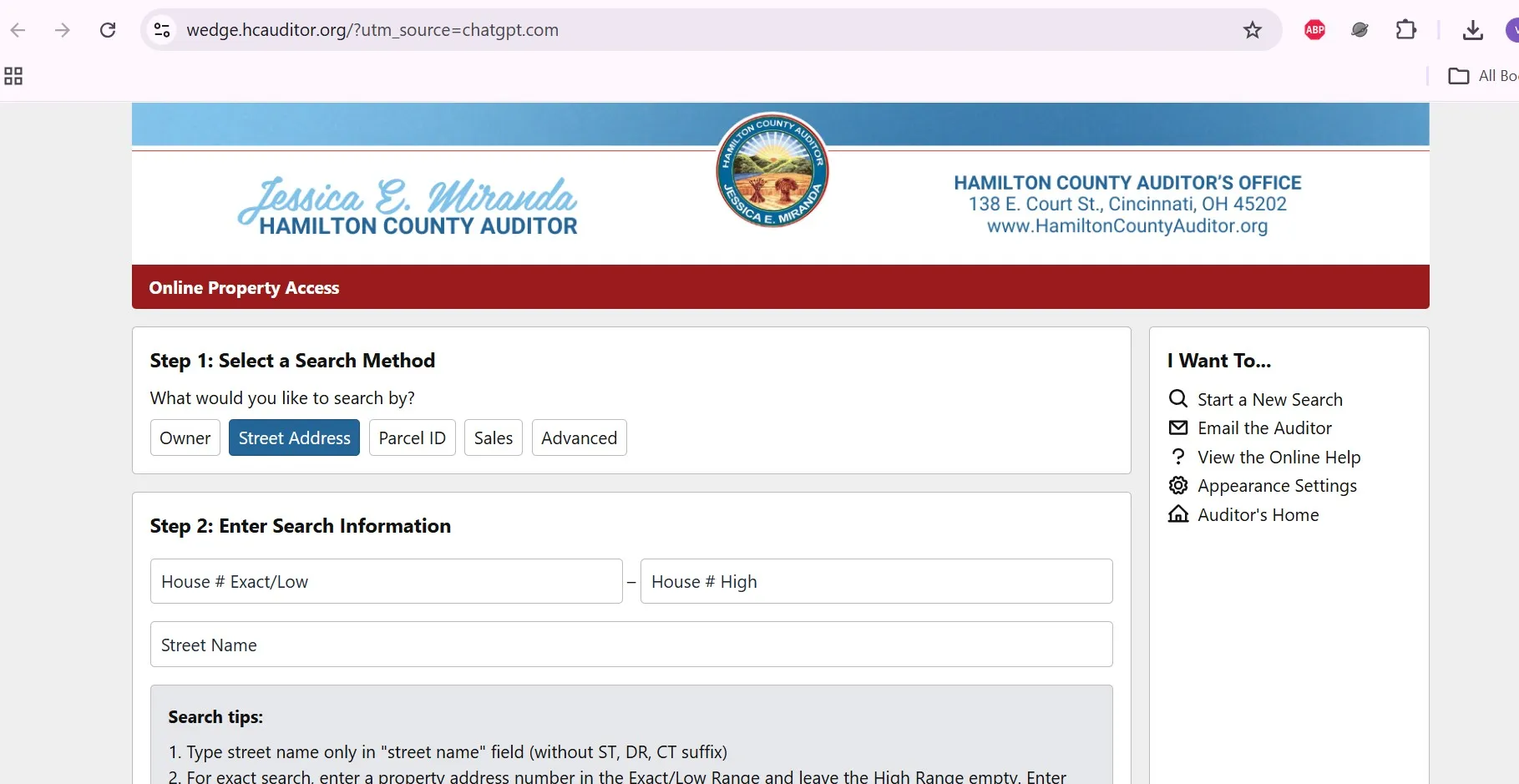
Use one search method at a time. Start broad, open the likely result and verify it using at least two independent parcel details.
- Select Owner.
- Enter the legal surname first.
- Add the first name or initial only if needed.
- Match the result by address and parcel ID.
JONES JO
- Place the number in Exact/Low.
- Leave High blank for one address.
- Enter the main street name only.
- Remove ST, RD, DR, CT and AVE initially.
138 COURT
- Copy the ID from a bill or county letter.
- Use all 13 characters for an exact record.
- Use a partial number only for related parcels.
- Verify the property address after opening it.
176-0015-0301-00
Owner-name tricks that save time
Address tricks for difficult properties
Use Sales and Advanced search only when needed
Sales search is useful for transfer dates, prices, book and page, year built and square-footage research. Advanced search can combine owner, address, building, appraisal-area, school-district and land-use criteria.
Save these details before leaving the result
Property not found? Follow this order
Prepare this before contacting the county
Read the parcel record without misinterpreting it
Section |
What it shows |
Useful next action |
|---|---|---|
Property Summary |
Parcel ID, owner, addresses, tax district, school district, use, value and transfer summary. |
Confirm the parcel before using tax, deed or map tools. |
Appraisal Information |
Building facts, land details, appraisal area and value components. |
Check square footage, age, condition, use, garage, basement and improvements. |
Levy Information |
Applicable levies and tax-rate information. |
Separate value concerns from tax-rate concerns. |
Transfer |
Transfer date, price, deed type, prior owner, current owner and conveyance clues. |
Use the Recorder for the document itself. |
Value History |
Market and assessed values over multiple years. |
Compare changes with reappraisal, construction, demolition or correction activity. |
Board of Revision |
Prior complaint history and results where available. |
Review earlier decisions before filing another complaint. |
Payment Detail |
Bills, payments, corrections, adjustments and delinquency. |
Contact the Treasurer for the official current balance. |
Tax Distributions |
Market value, assessed value, rates, credits, reductions and tax distribution. |
Compare only parcels in the same taxing district. |
Images and Sketches |
Available property photographs and building sketches. |
Compare the record with the property’s actual improvements. |
Special Assessment / Payoff |
Special-assessment or payoff information. |
Identify the public body responsible for the charge. |
Tax Lien Certificates |
Available tax-lien-certificate information. |
Obtain an official payoff or professional guidance when necessary. |
CAGIS / Aerial |
Parcel location, adjacent parcels and aerial context. |
Use a deed and survey for legal boundaries. |
Market value, assessed value and tax are not the same
2026 triennial update
Build a useful printable report
For purchase, tax or value research, select Property Summary, Appraisal Information, Transfer, Value History, Payment Detail, Tax Distributions, Parcel Photo, Sketches, Special Assessment/Payoff and Owner Names.
Check taxes without confusing the calculation and balance
Why similar houses can have different bills
Use the correct fix
Use the map to locate property—not establish boundaries
- Locating a parcel visually
- Checking adjacent parcels
- Comparing aerial imagery
- Understanding irregular lot shapes
- Resolving mailing-address confusion
- Exact boundary location
- Legal ownership
- Easement rights
- Permitted construction placement
- Marketable title
Find sales that genuinely compare with the property
A sale across the street is not automatically comparable. Match location, property type, size, age, condition and transfer circumstances.
- Appraisal area
- School district
- Neighborhood
- Traffic and surroundings
- Square footage
- Year built
- Land use
- Garage and basement
- Condition and renovation
- Recent transfer date
- Arm’s-length sale
- Similar number of parcels
- No family or distress-sale issue
Find deeds, mortgages, liens, easements and plats
Copy the parcel ID, owner name, prior owner, transfer date and book/page or conveyance clues from the Auditor. Then use the Recorder for the official recorded document.
Known information |
Search option |
Practical tip |
|---|---|---|
Owner or company |
Name |
Use surname plus first initial or a distinctive business phrase. |
Approximate period |
Date Range / Document Type |
Add the document category to remove unrelated records. |
Exact recorded date |
Record Date |
This finds documents recorded that day, not necessarily signed that day. |
Book and page |
Book / Page |
Copy both values exactly. |
Instrument number |
Document Number |
Use the complete number when available. |
Parcel ID |
Auditor Number |
Add a date or document type if too many results appear. |
Subdivision and lot |
Subdivision / Lot |
Use the exact subdivision name and lot number. |
Section, town and range |
Legal Description |
Enter only the parts you can verify. |
Current copy and recording costs
Service |
Published fee |
Useful note |
|---|---|---|
Basic recording |
$34 for the first two pages |
$8 for each additional page. |
Certified copy |
$2 per page plus $1 certification |
Confirm page count before ordering. |
Self-service copy |
$0.10 per page |
Staff-made copies may use a different fee. |
Subdivision plat map |
$2 per map |
Provide the Recorder book and page—not only the Auditor parcel number. |
Credit-card convenience fee |
$2 or 2.39%, whichever is greater |
Debit-card fee is published separately as $2. |
Set up a Recording Notification Service alert
Hamilton County’s Recorder offers a free email alert when a new document is recorded using a monitored name.
- Monitor up to five name variations per email
- Send an email after a matching document is recorded
- Provide a link to review the record
- Remain active until edited or cancelled
- Prevent a document from being recorded
- Interpret legal meaning
- Alert for documents recorded before signup
- Monitor property in another county
Challenge value with evidence—not only a high tax bill
The Board of Revision reviews property value. It does not remove voter-approved levies or change the tax rate because the final bill increased.
Check these facts before filing
Match the evidence to the reason
Check each property-tax relief program separately
Program |
Main purpose |
Important check |
|---|---|---|
Owner Occupancy Credit |
Credit connected with a qualifying primary residence. |
Confirm it appears after a purchase or ownership change. |
Homestead Exemption |
Additional relief for eligible homeowners under statutory rules. |
Prior-owner eligibility does not automatically transfer. |
CAUV |
Values qualifying agricultural land according to agricultural use. |
Annual renewal, transfer forms and recoupment consequences matter. |
Tax Exemption / Remission |
Applies to qualifying property under Ohio exemption law. |
Eligibility depends on property use and statutory requirements. |
Destroyed or Damaged Property |
Requests value consideration after qualifying damage. |
Document the date, cause and extent of damage. |
Abatement / TIF |
Special value or tax treatment connected with qualifying development. |
Separate abated, exempt or TIF value from ordinary taxable value. |
After buying a property
Prepare a deed transfer, split or consolidation correctly
Transfer documents move through the Auditor to maintain ownership and parcel records and collect conveyance fees. Some legal descriptions also require County Engineer approval.
Common items to prepare
Published conveyance charges
Mistakes that delay processing
Call the correct Hamilton County property department
Question |
Contact |
Prepare before calling |
|---|---|---|
Property search or appraisal |
Parcel ID, address, owner and the field in question. |
|
Board of Revision |
Tax year, current value, requested value and evidence. |
|
Transfer / conveyance |
Deed, DTE form, price and parcel count. |
|
Homestead |
Parcel ID, occupancy and eligibility question. |
|
CAUV or exemption |
Acreage, use, filing status and form question. |
|
Abatement or TIF |
Parcel ID and project or exemption details. |
|
Tax payment |
Parcel ID, bill year, payment date and confirmation. |
|
Recorder general information |
Names, document type, date and document reference. |
Cincinnati, OH 45202
Published hours: 7:30 a.m.–4:00 p.m., Monday–Friday, excluding holidays.
The Recorder’s general office hours are 7:30 a.m.–4:00 p.m. The Recording Desk publishes an earlier 3:30 p.m. closing time.
Use the correct guide for a neighboring county
Hamilton County property search FAQs
How do I search Hamilton County property by owner name?
Choose Owner in the official Hamilton County Property Search. Enter the legal surname followed by the first name or first initial, such as JONES JO. Partial entries are accepted, so begin broadly and verify the result by address and parcel ID.
How do I search a Hamilton County property by street address?
Enter the house number in the Exact or Low field and enter the main street name without suffixes such as Street, Road, Drive, Avenue or Court. Leave the High field blank when searching one address.
Why does a valid Hamilton County mailing address not appear?
A USPS mailing address may not match the taxable-parcel address. Search a nearby address range, open Aerial Imagery and review the parcelmerged map layer to identify the underlying taxable parcel.
How long is a Hamilton County parcel number?
Most Hamilton County parcel numbers contain 13 characters. A partial parcel number can return related records, but all 13 characters should be entered when searching for one exact parcel.
What does tax year 2025 payable 2026 mean?
The value and tax calculation are associated with tax year 2025, while the resulting real-estate tax is billed and paid during 2026.
Are Hamilton County CAGIS parcel lines legally exact?
No. CAGIS parcel lines help locate property but are not legal boundary surveys. Use the recorded deed, approved plat and a licensed surveyor when exact boundaries matter.
Where can I find a Hamilton County deed, mortgage or lien?
Use the Hamilton County Recorder Public Document Inquiry. Searches can be run by name, date, document type, book and page, document number, subdivision, legal-description information or Auditor parcel number.
How do I challenge a Hamilton County property value?
Review the parcel facts and comparable sales, collect evidence and file the current DTE 1 complaint with the Hamilton County Board of Revision during the published filing period. Complaints cannot be submitted by email.
When will Hamilton County’s 2026 triennial values affect tax bills?
Hamilton County identifies 2026 as a triennial appraisal year, with new values expected to become effective on property-tax bills issued in January 2027.
What is the Hamilton County Auditor phone number and address?
The Hamilton County Auditor general-information number is 513-946-4000. The office is at 138 East Court Street, Cincinnati, Ohio 45202, with published hours of 7:30 a.m. to 4:00 p.m. Monday through Friday, excluding holidays.

Khushboo Bobade is the editor and digital publisher of CountyAuditors.org. She oversees the research and editorial process for the website, ensuring that information about county auditor offices, property records, and government resources is accurate, verified, and easy for visitors to understand.
10 Ohio Property Tax Calculators & Auditor Tools
Built specifically for Ohio's 35% assessment ratio, current DTE forms, and 2026 Homestead, Owner-Occupancy, CAUV, Conveyance Fee, and Board of Revision rules. Every number reflects verified Ohio Department of Taxation amounts.
Annual Tax Bill Estimator
OHIOApplies Ohio's 35% assessment ratio plus your county's effective millage tier — the actual math your auditor uses.
Homestead Reduction Calculator
DTE 105A2026 Ohio Homestead: $29,000 general or $58,000 enhanced (100% disabled vet, KIA spouse). OAGI under $41,000 required for non-veteran applicants.
Owner-Occupancy & Non-Business Credits
DTE 105CEvery Ohio owner-occupied home qualifies for the 2.5% Owner-Occupancy Credit plus the automatic 10% Non-Business Credit. Most owners don't realize these stack.
Conveyance Fee Calculator
ORC 322When you sell or transfer Ohio property, the auditor collects $1 state + up to $3 county per $1,000, plus $0.50 per parcel. Counties choose their rate.
CAUV Agricultural Savings
DTE 109Ohio's Current Agricultural Use Value cuts taxable value dramatically for farmland (10+ acres, or smaller with $2,500+ annual gross income).
Mill Rate Converter
Ohio tax rates appear three ways on auditor sites: mills, percent, or dollars per $1,000. Convert between them instantly.
Parcel Number Cleaner
Ohio's 88 counties each format parcels differently — Franklin uses 010-123456-00, Cuyahoga uses 001-23-456, Hamilton uses 100-0001-0001-00. Auto-detects.
35% Ratio Sanity Check
Ohio law sets taxable value at 35% of market value. If yours is significantly higher, you're a strong BOR appeal candidate.
BOR Appeal Savings
DTE 1A successful Board of Revision complaint typically cuts your value 10–20%. Filing is free and stays in effect until the next reappraisal.
BOR Deadline Countdown
MAR 31Ohio's statutory Board of Revision filing deadline is March 31 for the prior tax year. Miss it and you wait until next year — no extensions.
Verify with the official Ohio source
These calculators use the verified 2026 Ohio Department of Taxation amounts and statutory rules. For your exact bill, exemption status, and county-specific deadlines, always confirm with your county auditor and the Ohio Revised Code:
Estimates use Ohio's 35% statutory assessment ratio and effective tax rate tiers averaged across major Ohio counties. Your actual bill depends on local school levies, voted millage, inside vs. outside millage splits, House Bill 920 reduction factors (HB 920), and special assessments. The 2026 Homestead general amount ($29,000) and enhanced amount ($58,000) reflect HB 187 inflation indexing — your county auditor's office may show slightly different transitional figures. Nothing here is legal or tax advice. CountyAuditors.org is an independent informational directory, not affiliated with any county government.